
Polymorphic Organisations Part XIV - Change Has Nowhere to Live
Change is the topic again - and this time, it's homeless.

Why Organisation Design - not intent, effort, or mindset - is the real frontier of transformation.
For a long time now, I’ve felt uneasy about how we talk about change at work. Not abject disagreement or frustration. Unease.
Because the dominant language of organisational change still assumes that change is something we do to an organisation, rather than something the organisation must be designed to host. We plan it, programme it, cascade it, manage it, communicate it, measure it, and then - often with a mixture of confusion and fatigue - watch it stall, fragment, or quietly dissolve back into business as usual.
We usually explain this away in human terms. Leaders weren’t aligned. People resisted. The culture wasn’t ready. Middle managers blocked it. The narrative didn’t land.
All of those things can be true. And still miss the point.
What I’ve increasingly come to believe- through client work, theory, failed experiments, near-misses, and late-stage reflection - is that most change efforts fail for a simpler, more structural reason:
Change has nowhere to live.
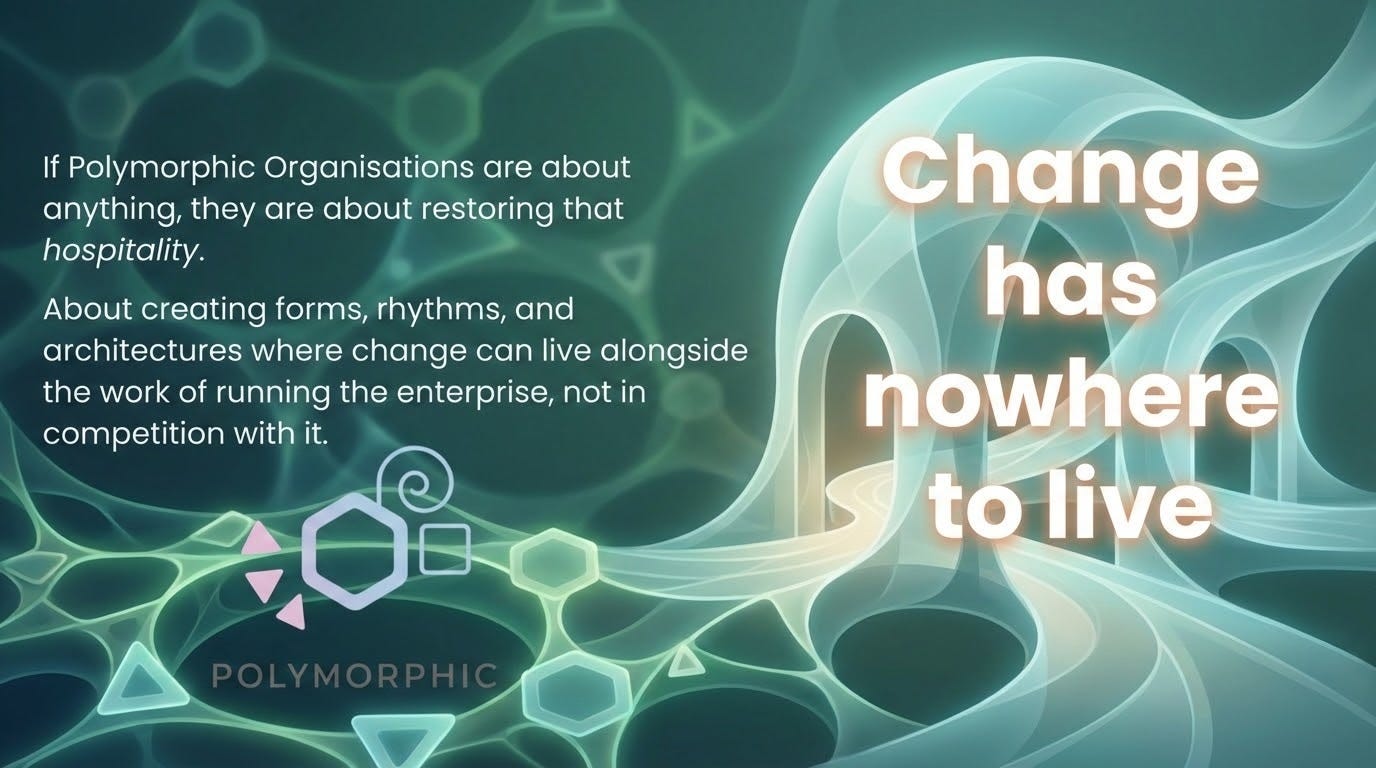
It exists everywhere rhetorically, but nowhere legitimately. It floats between strategy decks and project plans, carried by goodwill and heroics, rather than held by design. It is expected to coexist with operational delivery, legacy systems, and quarterly targets, but without a form, a cadence, or a stable place in the organisational architecture.
Change, in most organisations, is functionally homeless.
The quiet assumption that breaks everything
Modern organisations are still largely designed around a single organising logic: run the business.
Roles, budgets, governance, incentives, reporting lines, performance management, risk controls, and decision rights all cluster around this logic. Even where innovation functions or transformation offices exist, they tend to be adjuncts to the core rather than structural peers.
Change, by contrast, is treated as exceptional. Temporary. Episodic.
It is something we “make space for” rather than something the system is built to accommodate. We ask people to stretch, to juggle, to prioritise differently, to bring energy and imagination to the future while still delivering the present. And then we act surprised when they burn out, disengage, or default to the safest available behaviours.
This isn’t a failure of commitment.
It’s a failure of design.
If we take Systems Thinking seriously - and we should - then we have to accept a difficult truth: Organisations are already perfectly designed to produce the outcomes they are getting. Including stalled change, cyclical reinventions, and transformation fatigue.
POSIWID.
POSIWID, an acronym for "The Purpose Of a System Is What It Does," is a concept from Management Cybernetics by Stafford Beer, meaning a system's true purpose isn't its stated goal, but its actual, observable output. And highlighting discrepancies between intent and results, such as a company claiming to be green while polluting.
It's used in Systems Thinking to analyse real behaviour, uncover flaws, and improve performance by focusing on outcomes rather than rhetoric, often revealing hypocritical actions or unintended consequences.
The emerging insight: Unowned work as a signal
One of the most interesting threads emerging across systems thinking, organisational design, and complexity practice is the growing attention to work that no one owns.
Not work that is neglected because people don’t care, but work that structurally doesn’t belong anywhere.
Work that falls between functions.
Work that sits across silos.
Work that is everyone’s responsibility in theory, and no one’s in practice.
Change work is the most persistent example of this phenomenon.
It requires coordination across boundaries, authority without hierarchy, learning without certainty, and progress without guaranteed outcomes. Traditional organisational forms struggle to host this kind of work because they are optimised for predictability, repeatability, and control.
So change gets pushed into projects. Or programmes. Or cultural initiatives. Or transformation offices. Or heroic leaders with exceptional tolerance for ambiguity.
Sometimes this works, briefly. More often, it creates a parallel universe of effort that never quite reconnects with the operational core.
The organisation continues to run. Change continues to try. And the gap between them widens.
Polymorphic Organisations: A different starting point
This is where I hope my work on Polymorphic Organisations really begins to matter, not as a model to be implemented, but as a different way of seeing Organisation Design.
Polymorphic, in the most literal sense, means “many forms”. In biology, in computing, in systems theory, Polymorphism describes entities that can take multiple shapes depending on context, without losing their underlying identity.
Applied to organisations, this suggests a shift away from singular, fixed structures toward adaptive forms that can coexist, overlap, and evolve. It challenges the assumption that an organisation must choose between stability and change, legacy and future, efficiency and exploration.
Instead, it asks a different question:
What if organisations were designed to host multiple modes of work simultaneously, without forcing them into a single shape?
In this framing, change is not something layered onto the organisation. It is something the organisation is structurally capable of holding.
Oscillation, not Transformation
One of the ideas that has become central to my thinking is Organisational Oscillation.
Most organisations treat change as a directional journey: From current state to future state, from old to new, from legacy to transformation. This creates a psychological and structural bias toward replacement rather than coexistence.
In reality, my sense is that healthy systems oscillate.
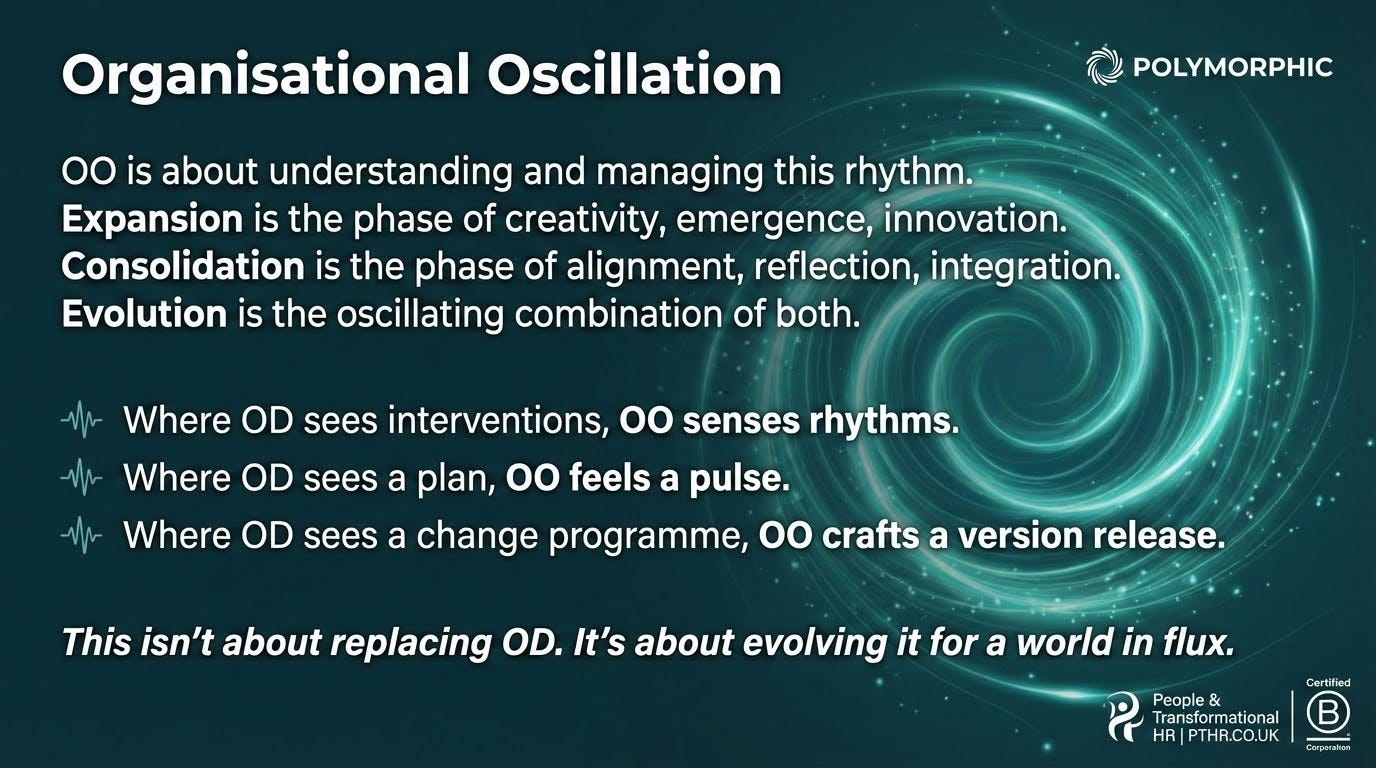
They expand and consolidate. They explore and exploit. They diverge and converge.
They experiment at the edges and stabilise at the core. This is not a failure of commitment to the future; it is how complex systems remain viable over time.
When we design organisations as if they must permanently “move on” from the past, we create unnecessary conflict between future-facing work and the operational backbone that sustains the enterprise.
Polymorphic design treats run, serve, and change not as functions or phases, but as energetic modes that flow through the system. Sometimes the system needs consolidation. Sometimes it needs exploration. Sometimes it needs enablement and connective tissue.
The problem arises when only one of these modes is structurally privileged.
What “structurally privileged” actually means
When I say one mode is structurally privileged, I don’t mean it is explicitly valued more.
I mean it is:
Easier to justify
Easier to fund
Easier to defend
Easier to measure
Easier to protect when things get tight
Structural privilege shows up in design, not rhetoric.
So in most organisations:
Run is structurally privileged
because it has roles, budgets, KPIs, governance, risk cover, and status.Serve is semi-privileged
tolerated when it improves efficiency, cut when it doesn’t show immediate ROI.Change is conditionally privileged
celebrated in strategy decks, marginalised in operating reality.
No one says this out loud.
The structure says it for them.
Why this matters more than mindset or culture
The critical move Polymorphic makes is this:
Structural privilege determines which forms of work survive pressure.
When:
revenue dips
a CEO changes
the market tightens
confidence wobbles
people do not fall back on values or narratives.
They fall back on what the system is designed to protect.
That is why:
change is paused “temporarily”
enablement teams are rebranded or dissolved
innovation is asked to “wait until things stabilise”
Stability is not neutral.
It is defended.
The deeper systems’ truth underneath this
From a systems-theory perspective, this is not accidental.
A system always optimises for what it measures, rewards, penalises and it legitimises.
Structural privilege emerges from:
where authority sits
how decisions are made under uncertainty
which work is considered “real” when trade-offs appear
So when only one mode is structurally privileged, the organisation doesn’t oscillate.
It snaps back.
What “structural privilege” looks like in practice
Using the BAU (Business As Usual) frame, we can see it more clearly in this kind of framing with illustrations like:
BAU work has owners; change work has sponsors
BAU work has budgets; change work has business cases
BAU work has roles; change work has volunteers
BAU work has governance; change work has updates
BAU work has career paths; change work has overwork and often burnout
None of this is malicious. It is simply what the design seems to make inevitable.
Why Polymorphic design reframes the problem
Polymorphic design doesn’t try to equalise the modes morally. It equalises them structurally.
That’s a crucial distinction. It says:
Deliver, Enable, and Change are all legitimate forms of value creation
Each requires different rhythms, protections, and success criteria
None should have to masquerade as the other to survive
This is not balance. It is design justice inside the organisation.
Where change falls apart in practice
Let me ground this in lived experience.
Several years ago, I worked with a global organisation on what we called an “Epic Story” initiative. On the surface, it looked like a narrative and engagement project. Underneath, it was something more ambitious: an attempt to give change work a legitimate, designed home in order to drive towards a 2030 growth vision and strategy.
The model was to form cross-functional, time-bound Squads. We would treat the work of change as production, not participation. We had established cadence, roles, decision rights, and learning loops. We created an open, enabling infrastructure rather than a controlling PMO. We explicitly acknowledged that people still had “day jobs” and designed capacity accordingly.
It was, in hindsight, a proto-polymorphic move.
And then the CEO changed.
The new leader “knew best”. The initiative was quietly stopped. The organisation reverted to familiar patterns. Not because the design was unsound, but because its legitimacy was still person-dependent rather than constitutionally embedded.
That experience crystallised something important for me:
Change cannot rely on sponsorship alone. It needs design-level legitimacy.
If the right to explore, adapt, and evolve is not structurally encoded, it will always be vulnerable to shifts in power, preference, or personality.
A detour through software: why OOD and OOP matter here.
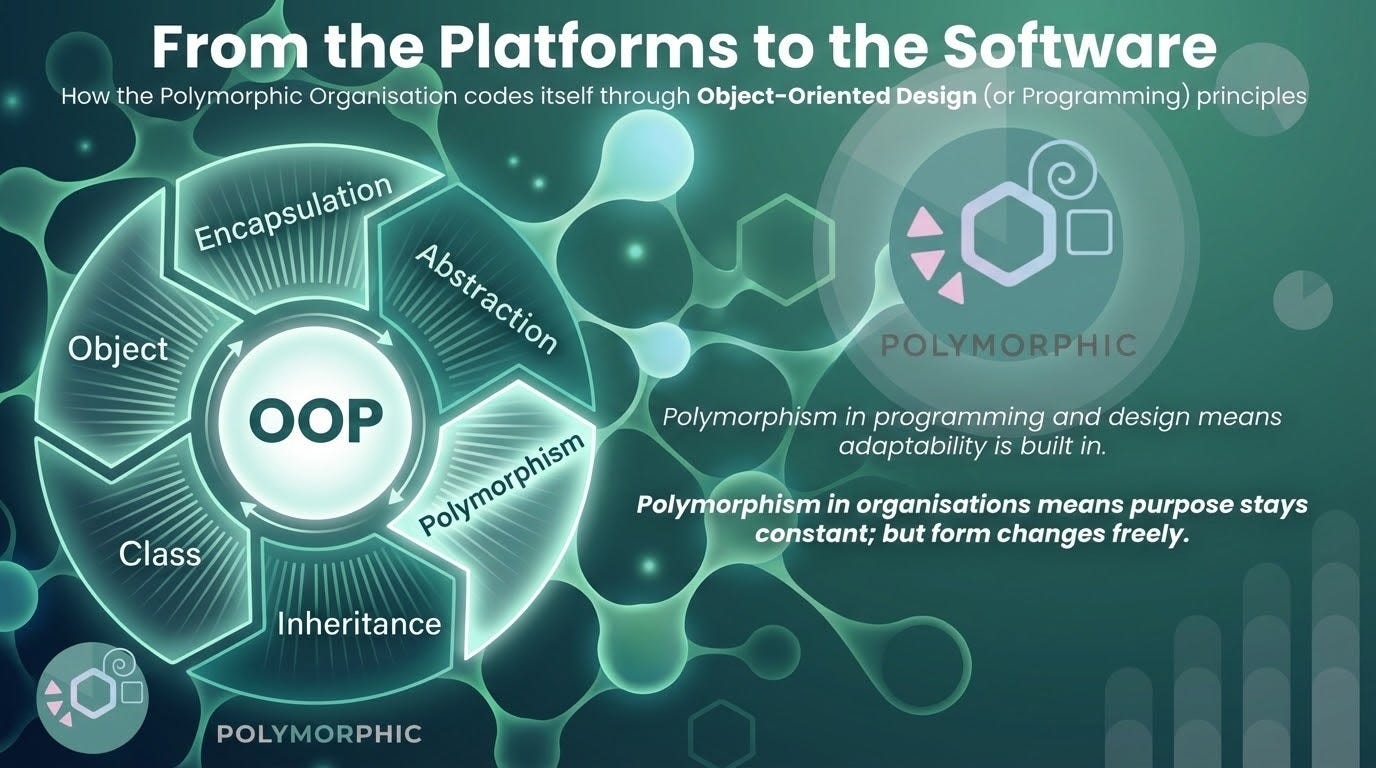
Interestingly, some of the clearest language for this problem comes not from management theory, but from object-oriented design and programming.
OOD and OOP emerged to solve a similar challenge: how to build systems that can evolve over time without becoming brittle, over-coupled, or impossible to change.
While different schools enumerate the principles slightly differently, there is broad agreement around seven core ideas. When viewed organisationally, they offer a surprisingly powerful lens for rethinking how change and business-as-usual coexist.
1. Encapsulation
Encapsulation is about giving elements of a system clear boundaries and internal coherence. In organisations, change work often lacks encapsulation. It bleeds into everything, is interrupted by everything, and is constantly overridden by operational urgency.
Polymorphic design asks: What would it mean to encapsulate change work without isolating it? To give it protected space, time, and authority, while still enabling interaction with the rest of the system.
2. Abstraction
Abstraction allows systems to focus on purpose rather than implementation detail. Many organisations drown change in excessive specificity too early, demanding business cases, milestones, and certainty before learning has occurred.
A polymorphic approach holds change at the right level of abstraction for its stage, allowing intent and direction to guide exploration before optimisation takes over.
3. Polymorphism
In software, polymorphism allows the same interface to behave differently depending on context. Organisationally, this maps to the idea that the same organisation can legitimately operate in different modes at the same time.
Change does not need to look like operations. Nor should it. Expecting them to conform to the same rhythms and metrics is a category error.
4. Inheritance
Inheritance is often misunderstood as rigidity, but at its best it allows new forms to build on existing capabilities rather than starting from scratch.
Too many change efforts treat the past as something to escape. Polymorphic organisations treat legacy as a resource, selectively inherited and recombined rather than wholesale replaced.
5. Composition
Composition favours assembling systems from smaller, interchangeable parts rather than monolithic designs. This is directly relevant to change work, which benefits from being modular, iterative, and recombinable.
Large, all-or-nothing transformations struggle because they are fragile. Composed change, by contrast, can adapt as it goes.
6. Modularity
Modularity reduces coupling and increases adaptability. In organisational terms, this suggests designing change initiatives so that failure in one area does not cascade across the system.
It also means allowing different parts of the organisation to evolve at different speeds without forcing synchronisation.
7. Message passing (or interfaces)
In software, objects interact through defined interfaces rather than direct interference. Organisationally, this maps to clarity about how change work interacts with operations, governance, and leadership.
Most change fails not because people don’t care, but because decision rights, feedback loops, and escalation paths are undefined or contradictory.
Seen this way, OOD/OOP principles offer a language for coexistence without chaos. They show us how systems can be designed to change safely, continuously, and coherently.
HR 3.0 and the three energies
This also connects directly to my work on HR 3.0, particularly the three energies that underpin it: Deliberate, Diversified, and Dynamic.
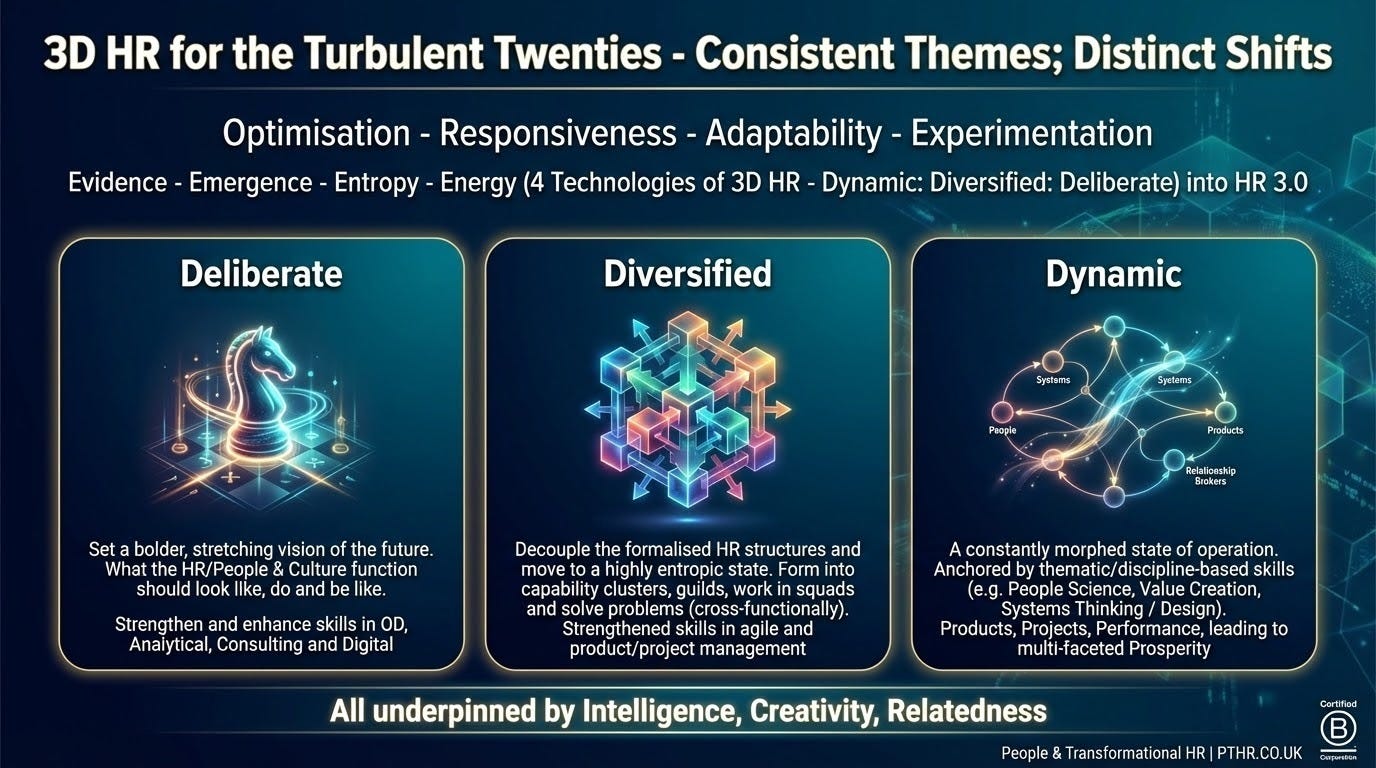
Change without deliberateness becomes restless. Change without diversification becomes narrow and elitist. Change without dynamism becomes theatre.
A polymorphic approach to change embodies all three energies:
Deliberate in its design, legitimacy, and intent.
Diversified in who participates, how work is shaped, and where authority sits.
Dynamic in its rhythms, forms, and ability to adapt over time.
HR, when operating as a design discipline rather than a service function, has a critical role to play here. Not as the owner of change, but as the steward of the conditions that allow change to live.
So what actually needs to shift?
This is not a call for more frameworks, programmes, or transformation methodologies. It is a call for design courage.
It requires leaders to accept that:
Stability and change are not opposites.
Legacy and future can coexist.
Control is not the same as coherence.
And culture does not compensate for poor design.
It asks organisations to move from asking “How do we get people to change?” to asking “What kind of organisation would make change a natural, supported activity rather than an act of defiance?”
That is a much harder question. And a far more interesting one.
A call to action and a closing reflection
If this idea of “change having nowhere to live” resonates, there are a few questions worth sitting with—not as a checklist, but as a design prompt:
Where in your organisation does change work currently sit?
Which forms of work are structurally protected when pressure rises- and which quietly become optional?
What important work is visible to everyone, yet owned by no one?
And if your organisation had to change shape without changing people, what would actually need redesigning?
And finally…
I don’t believe change is failing because people are tired, cynical, or incapable. If people are feeling those things, it’s the system of change that’s at fault and causing this. We know we can and need to keep evolving, changing and adapting.
I believe change (in its current guise of programmes, curves, models and theories) is failing because we keep asking it to survive in environments that were never designed to host it.
If Polymorphic Organisations are about anything, they are about restoring that hospitality.
About creating forms, rhythms, and architectures where change can live alongside the work of running the enterprise, not in competition with it.
Change does not need more passion. It needs a place to belong.
And that, ultimately, is a design challenge we all need to face, lean into, be clearer about and get on with, sustainably, smartly and soulfully.
Post Script:
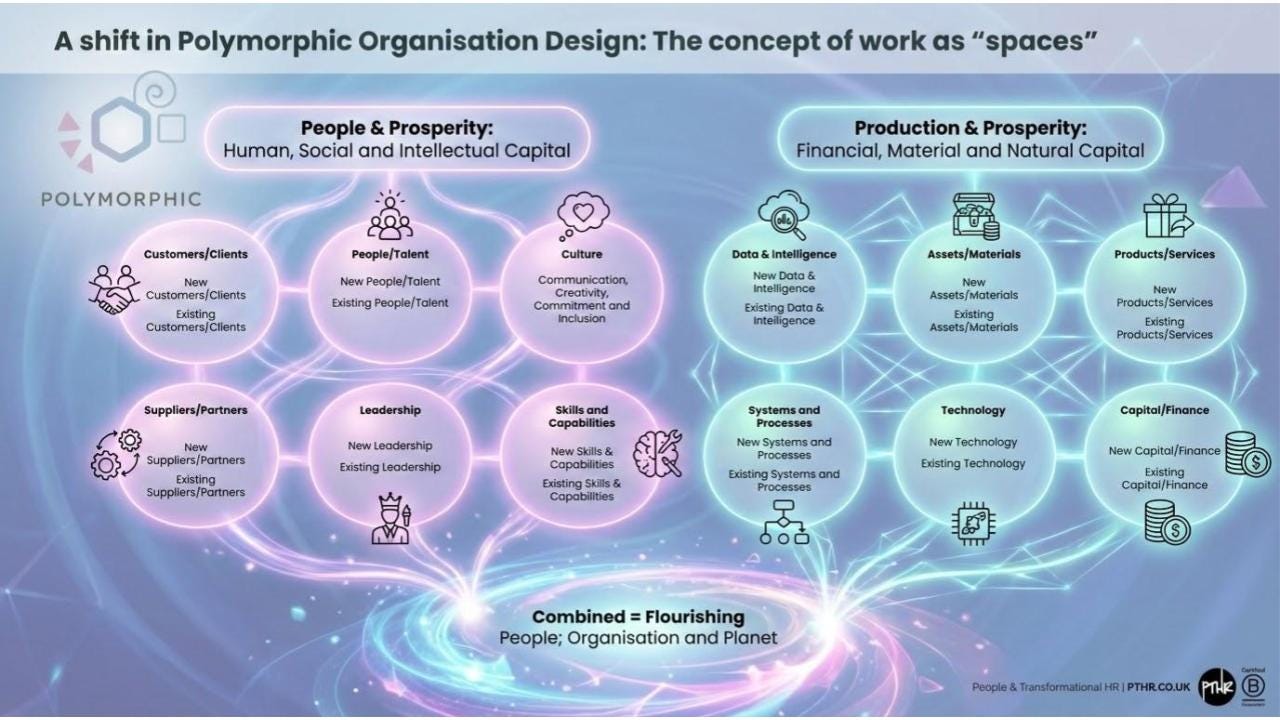
What “spaces” solve that structures can’t
Traditional organisation design answers the question:
Who owns this work?
Your spaces concept answers a more fundamental one:
Where can this work exist without being forced to become something it isn’t?
That distinction matters because change work dies the moment it is forced to masquerade as BAU.
Spaces are not:
teams
functions
phases or
roles
They are legitimate containers for work that does not yet know its final form.
This is precisely why they matter for change.
2. Why “change has nowhere to live” in conventional design
In most organisations, work can only live in three places:
Functions (owned, stable, optimised)
Projects (temporary, justified, deliverable-bound)
Initiatives (sponsored, fragile, political)
Change fits none of these cleanly.
It is ongoing, not temporary. Emergent, not fully specifiable. Cross-cutting, not ownable. Learning-led, not output-predictable
So it becomes homeless.
The spaces concept introduces a fourth ontological category:
Work that is real, valuable, and necessary — without being fully formed yet.
That’s a big deal.
3.The “change needs a home” lens
Let’s reinterpret this diagrammatic interpretation of space explicitly through that frame.
People & Prosperity spaces
(Human, Social, Intellectual capital)
These are not HR domains.
They are adaptive spaces where:
new people meet existing capability
leadership evolves rather than “steps up”
culture is shaped through interaction, not messaging
skills are recombined, not just upskilled
Change lives here as capability formation, not as intervention.
Crucially:
these spaces allow legacy and future to coexist
nothing has to be “finished” to be legitimate
That directly addresses the homelessness problem.
Production & Prosperity spaces
(Financial, Material, Natural capital)
Likewise, these are not operational silos.
They are evolutionary spaces where:
new and existing systems coexist
technology is integrated, not imposed
assets are reconfigured over time
data and intelligence mature through use
Change here is structural and material, not cultural theatre.
Again: it has somewhere to live while it is becoming.
4. Why spaces neutralise structural privilege
This is the really important connection to the earlier argument.
Structural privilege arises when:
only one form of work has legitimacy
everything else must justify itself in that form
Spaces quietly dismantle that hierarchy.
They do this by:
decoupling legitimacy from permanence
decoupling value from ownership
decoupling contribution from role
In a spaces-based design:
Run work lives in spaces optimised for reliability
Serve work lives in spaces optimised for flow and enablement
Change work lives in spaces optimised for emergence and learning
None of these has to pretend to be the other.
That’s the structural move we need to be circling on.
5. Spaces make oscillation possible (not aspirational)
Back to Organisational Oscillation. Spaces are the mechanism that makes oscillation real.
Without spaces:
oscillation is rhetorical (“we need to both innovate and optimise”)
leaders are asked to hold contradictions personally
people experience whiplash
With spaces:
different modes of work can operate in parallel
consolidation and exploration are both legitimate
the organisation breathes structurally, not psychologically
Change doesn’t have to “wait its turn”.
It already has a place.
Perry, from your experience, do you think organizations are open or willing to change?
This piece encapsulates HR and wider Occupational Sciences preference for the study of what is in someone’s head (mindsets, personalities, IQ) and less about what someone’s head is in- systems, affordances and emergence.