The Polymorphic Organisation - Episode XXXIII - The Collapse of Time
Why we're all so crunched and what we can do about "time poverty"

This Chronicle - 33 - really matters.
Not in the shallow “angel numbers on Instagram” sense. In the deeper sense that humans have always used numbers to create meaning around thresholds, transitions and time itself.
Thirty-three sits in strange territory. It is the age associated with transformation and sacrifice in Christian tradition. Dante’s Divine Comedy is structured around it.
In numerology, 33 is sometimes called the “master teacher” number - linked to compassion, responsibility, consciousness and service beyond the self.
But there’s another reason it fits this piece.
33 is the age at which many people first realise that time is not infinite.
Not intellectually. Somatically. You feel it.
You stop experiencing life as an endless horizon and begin experiencing it as allocation. And that’s exactly where this Chronicle wants to go.
Not productivity hacks, nor optimisation culture, and certainly not “five ways to reclaim your morning.” But the deeper phenomenon:
Why does modern life feel like it is accelerating beyond human scale?
Why do so many people — even successful, capable, privileged people — feel permanently late to their own existence?And what would a Polymorphic Organisation do differently?
This needs rhythm. Reflection. Science. Philosophy. Sociology. Systems thinking. And practical liberation.
So here’s the piece.
Polymorphic Brewing: Chronicle 33
The Collapse of Time
There is something happening to time.
Not clocks.
Not calendars.
Not astronomy.
Human time.
The felt experience of living; and almost everyone I speak to senses it now.
Time feels compressed.
Fragmented.
Over-allocated.
Hyper-scheduled.
Perpetually consumed before we have even arrived inside it.
Whole weeks disappear in administrative fog; we optimise calendars while starving meaning; we “save time” with technology only to discover the saved time has immediately been recolonised by more work, more expectation, more communication, more obligation, more availability.
It feels harder to breathe inside modern life.
Harder to wander, to disappear into curiosity, to follow instinct and certainly harder to do something gloriously unnecessary.
The other day I saw a post from someone attending an event in the USA and my first thought was not excitement - but astonishment.
Ten years ago, that would have been me. I would have booked flights impulsively.
Thrown things into a bag and followed an idea across continents. Said yes before practicality had chance to intervene.
Now?
I look at my calendar like an air traffic controller managing an overwhelmed runway system.
Client work.
Projects.
Writing.
Thinking.
Relationships.
Family.
Admin.
Travel.
Preparation.
Recovery.
Life maintenance.
Every day feels like a negotiation between competing urgencies. And I know I’m not alone. People everywhere are quietly asking the same question:
What happened to time?
The Great Compression
There is actual science behind this and several streams of research now point toward what sociologists and psychologists describe as temporal compression.
Put simply, human beings are experiencing more cognitive, emotional and informational events per unit of time than at any point in history.
The brain does not experience time objectively. It experiences density, and modern life is extraordinarily dense.
Emails.
Notifications.
Meetings.
Context switching.
Platform hopping.
Infinite media.
Infinite comparison.
Infinite updates.
Infinite access.
Even rest has become informational.
We no longer merely sit quietly. We consume while recovering.
Music.
Podcasts.
Videos.
News.
Threads.
Messages.
Content.
The mind rarely empties now.
And when the brain cannot consolidate experience properly, time begins to feel faster.
There’s compelling neuroscience behind this.
Memory formation plays a huge role in our perception of time. Novelty-rich experiences create deeper encoding in the hippocampus, making periods of life feel expansive in retrospect. Repetition and administrative sameness do the opposite.
This is why childhood summers felt endless. Everything was new.
Now? Many adults experience weeks composed largely of operational repetition.
The brain stops richly encoding.
Life becomes cognitively flattened.
And time appears to accelerate.
But there’s another layer too.
The sociologist Hartmut Rosa calls this social acceleration.
Technology was supposed to create leisure. Instead, every technological gain increased expectations.
Email sped communication up — so now we expect rapid replies.
Remote work created flexibility — so now availability became permanent.
AI increases productivity — so organisations increase output expectations.
Every efficiency gain becomes absorbed into the system.
We do not gain time - we intensify activity.
This is one of the great illusions of modernity.
We solved for speed but not for sufficiency.
The Tyranny of Infinite Accessibility
There used to be natural boundaries around human existence.
The office closed.
Shops shut.
Letters took days.
People disappeared for weekends.
Travelling meant genuine absence.
Now we exist inside perpetual partial presence: Always reachable, potentially responsive, always slightly “on.”
And this matters psychologically far more than many organisations realise. Because humans are not merely exhausted by work volume.
We are exhausted by anticipatory cognition.
The constant low-level awareness that something may require us at any moment. This creates what neuroscientists sometimes call continuous partial attention. You never fully arrive anywhere.
Not in work. Not in rest. Not even in relationships.
Part of the mind remains scanning. And when the nervous system cannot fully complete cycles of attention and restoration, time itself begins to feel hostile.
This is why people increasingly describe modern life with phrases like:
“I’m drowning.”
“I can’t catch up.”
“I’m behind.”
“I never stop.”
“I don’t know where the year went.”
These are not merely metaphors.
They are symptoms of systemic temporal overload.
The Hidden Economics of Time Poverty
What fascinates me is that time poverty increasingly affects even people with relative privilege. Historically, we associated time scarcity with material hardship alone. But now highly educated professionals, leaders, consultants, creatives and knowledge workers often feel profoundly time-poor despite technological abundance.
Why?
Because modern economies increasingly monetise attention itself. Not simply labour.
Attention.
And attention is temporal.
Every platform competes to occupy human consciousness.
Every organisation seeks responsiveness.
Every system seeks engagement
Every algorithm seeks retention.
The result?
Humans increasingly experience themselves not as living beings, but as throughput systems. We become processors and administrators of escalating informational flow.
And something deeply human starts disappearing.
Wonder.
Presence.
Serendipity.
Drift.
Contemplation.
Silence.
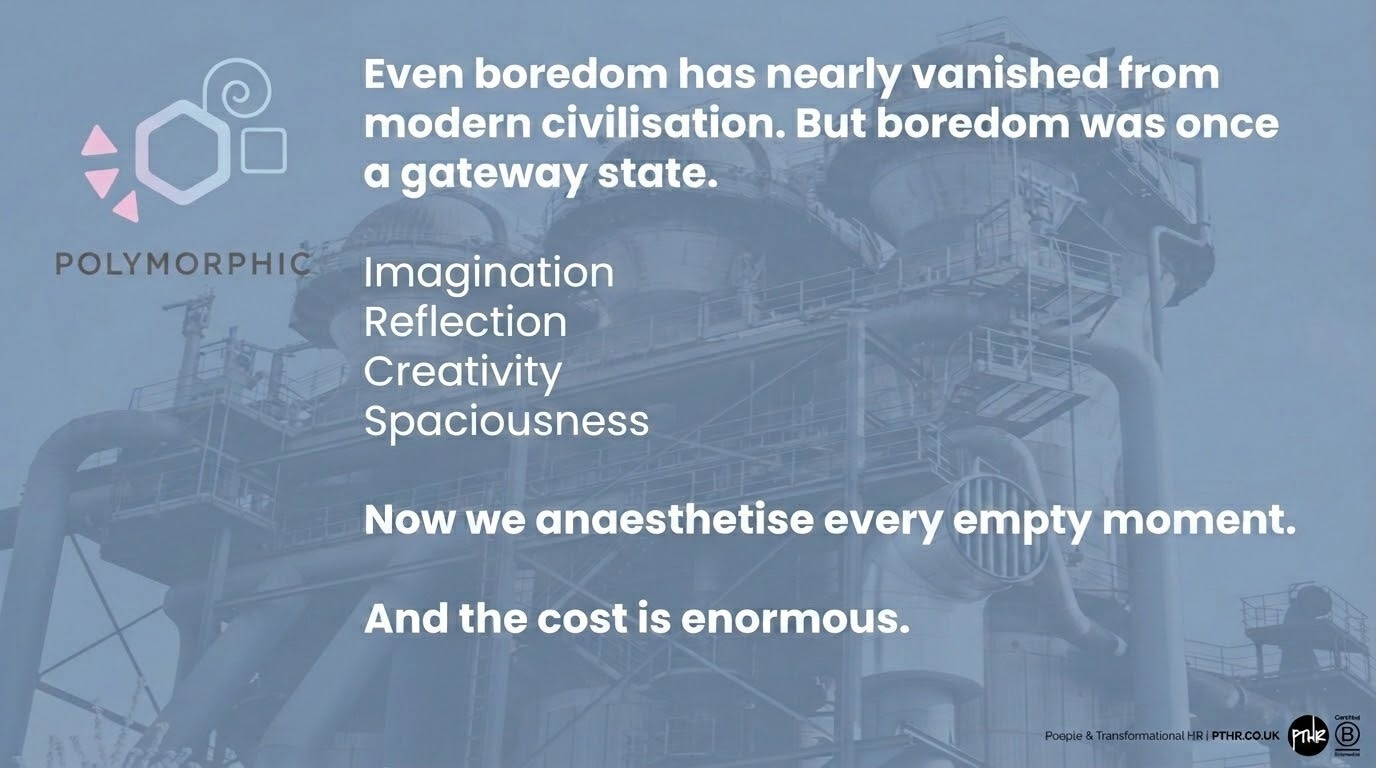
Even boredom has nearly vanished from modern civilisation. But boredom was once a gateway state.
It created imagination.
Reflection.
Creativity.
Spaciousness.
Now we anaesthetise every empty moment.
And the cost is enormous.
Butterfly Fields
More recently, I wrote about “Butterfly Fields” (Chronicle XXXII in fact).
It barely touched the algorithm, which is ironic really. Because it may have been one of the most important things I’ve written.
The Butterfly Field is the opposite of optimisation culture.
It is the idea that human flourishing requires unstructured ecological spaces where emergence can occur. Butterflies do not appear in concrete efficiency corridors; they appear in living fields.
Wildness, variation, pollination, movement and light. Human beings need psychological Butterfly Fields too.
Places where not every minute is monetised.
Where not every action is instrumental.
Where thought can wander.
Where conversations meander.
Where curiosity is allowed to lead without immediate utility.
Many organisations have systematically destroyed these spaces in pursuit of measurable efficiency. And then they wonder why creativity collapses, innovation stalls and engagement declines.
Why everyone feels permanently depleted despite productivity software, workflow systems and AI augmentation is because humans are not machines that improve infinitely through compression.
Past a certain point, compression destroys vitality.
The Organisational Lie
Most organisations still operate on an industrial assumption: That more output squeezed into less time equals progress. But this increasingly collides with biological reality - humans are rhythmic creatures and not linear ones.
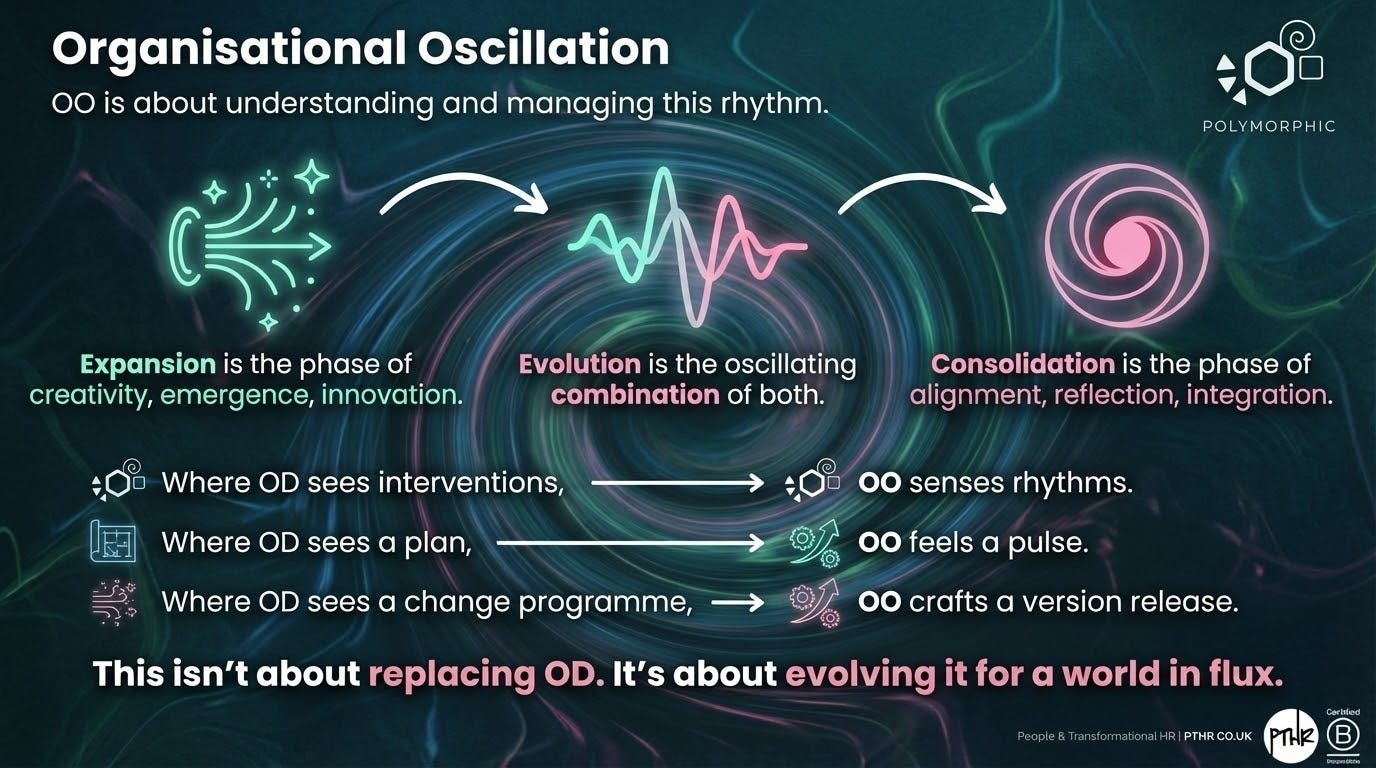
We oscillate.
We need cycles: Expansion and contraction; intensity and recovery; focus and diffusion; performance and reflection.
The industrial era distrusted rhythm because machines do not need restoration. Polymorphic Organisations see that recovering rhythm as strategic infrastructure.
Not wellness theatre, not mindfulness webinars, not resilience training designed to help people survive unsustainable systems.
Actual structural redesign.
Many organisations are not suffering from poor time management. They are suffering from temporal architecture failure. The system itself produces fragmentation.
And no amount of colour-coded calendars can solve structurally incoherent work.
Why “Time Management” Fails
Most time management advice fails because it treats humans like logistical problems.
Prioritise.
Optimise.
Batch.
Automate.
Delegate.
Some of this helps temporarily, but it rarely addresses existential overload. Because the deeper issue is not lack of scheduling skill; it is loss of sovereignty over attention.
People no longer feel ownership over their own cognitive landscape. And once that happens, life begins feeling externally authored. This is why even highly productive people increasingly feel strangely detached from their own existence.
They are moving constantly but rarely inhabiting their movement. The calendar becomes reality. And eventually people stop asking:
“What matters?”
They simply ask:
“What’s next?”
That is a dangerous transition.
Because “what’s next?” is infinite. There is always another thing.
Polymorphic Time
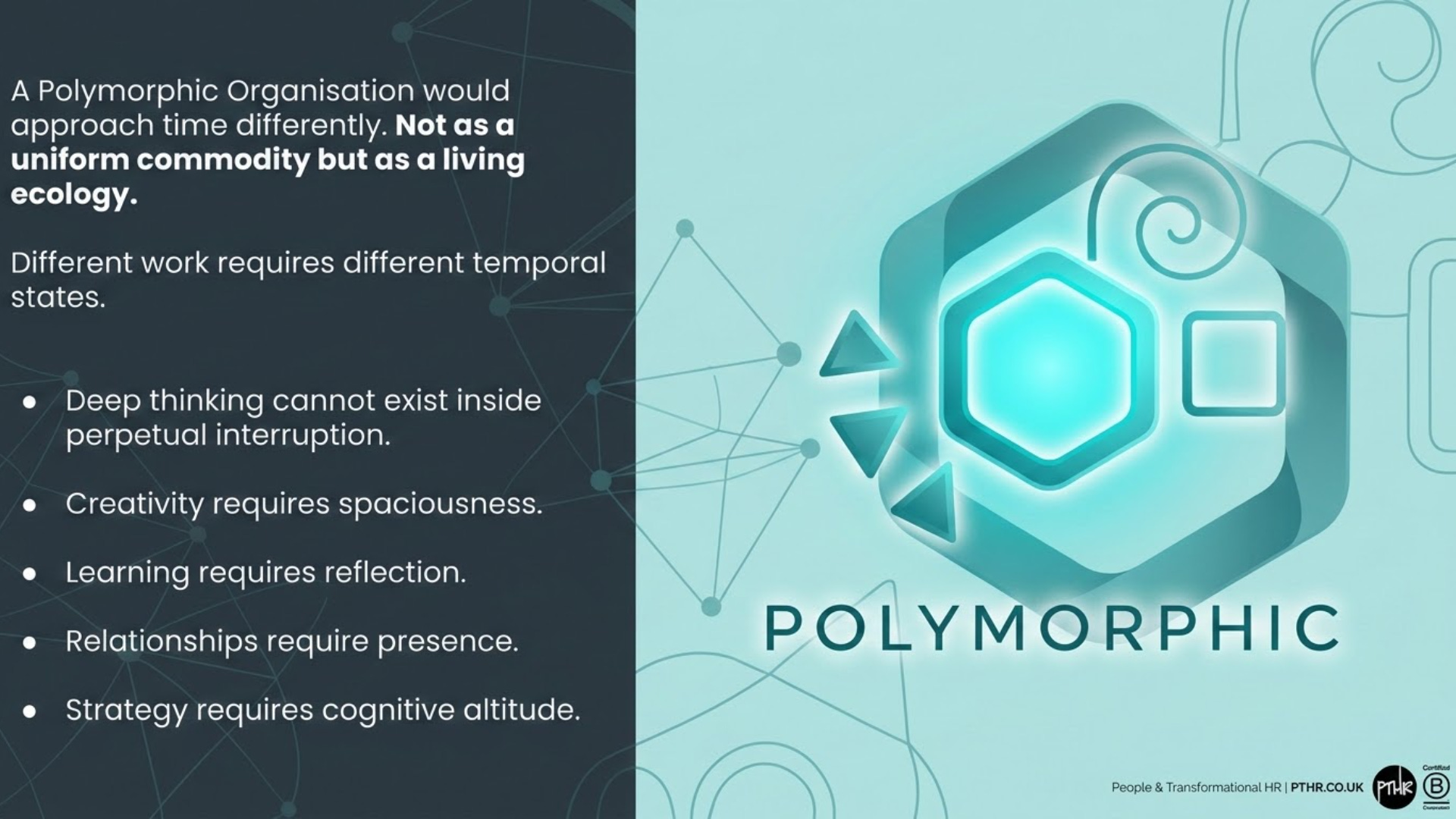
A Polymorphic Organisation would approach time differently. Not as a uniform commodity but as a living ecology.
Different work requires different temporal states.
Deep thinking cannot exist inside perpetual interruption.
Creativity requires spaciousness.
Learning requires reflection.
Relationships require presence.
Strategy requires cognitive altitude.
Yet most organisations force all forms of work into the same temporal container.
Meeting-heavy fragmentation.
Constant responsiveness.
Administrative overload.
Artificial urgency.
Polymorphic design asks a different question: “What temporal conditions allow humans to thrive and contribute meaningfully?”
That changes everything, because suddenly the objective is not squeezing more activity into the day: It is designing healthier temporal ecosystems.
And that leads to practical shifts. Real ones.
Not productivity cosplay.
Things That Actually Bend Time Back Toward Us
Not management - Recovery.
Not optimisation - Rehumanisation.
Here are some things I increasingly believe matter.
1. Protect Cognitive Monoculture Zones
Most people never fully enter deep thought anymore. Their cognition is shattered into fragments.
A Polymorphic Organisation should create sacred, uninterrupted zones for meaningful work.
No meetings.
No Slack.
No notifications.
No response expectations.
Just immersion.
One hour of uninterrupted deep cognition often produces more meaningful output than six hours of fractured attention.
2. Restore Temporal Diversity
Not every day should look the same. Humans need different temporal textures.
Some days expansive.
Some collaborative.
Some reflective.
Some exploratory.
Industrial work standardised time.
Polymorphic work diversifies it.
3. Stop Treating Availability as Commitment
Constant accessibility is not dedication.
Often it is anxiety.
Or performative responsiveness.
Or survival behaviour inside overloaded systems.
Healthy organisations should reward clarity and contribution - not digital hyper-presence.
4. Reintroduce Drift
Drift matters.
Walking without purpose.
Reading without extraction.
Conversations without agenda.
Thinking without deliverable.
Many breakthroughs emerge from non-linear cognitive wandering. The problem is modern systems classify all non-instrumental time as inefficiency.
But that “inefficiency” is often where humanity lives.
5. Design Organisational Breathing Spaces
Nature oscillates.
So should organisations.
Not every quarter should feel like emergency mobilisation.
There should be intentional cycles of consolidation, reflection and recovery.
This connects directly to Organisational Oscillation (see Chronicle XII here)
Constant acceleration eventually becomes organisational hypoxia.
6. Reduce Administrative Gravity
Many people are not overwhelmed by meaningful work.
They are overwhelmed by coordination overhead.
Approvals.
Status updates.
Duplicated systems.
Meetings about meetings.
Workflow administration.
Organisations often mistake administrative activity for operational sophistication.
Usually it is just drag.
7. Recover Presence Rituals
One of the reasons older social structures felt slower was ritual.
Meals.
Conversations.
Communal pauses.
Seasonal rhythms.
Modern work culture atomised many of these.
Polymorphic cultures should intentionally restore collective moments of presence.
Not forced fun. Human anchoring.
The Real Scarcity
I don’t actually think time is the scarcest resource anymore.
Attention is.
And beneath attention sits something even more precious:
Aliveness.
That feeling of actually inhabiting your own life while it is happening. Not merely administrating it. And maybe that is why so many people feel emotionally exhausted despite achieving so much. Achievement without temporal spaciousness becomes strangely hollow.
You arrive at the thing only to discover you were never really there for the journey toward it.
Chronicle 33
Maybe that’s why this Chronicle needed to be number 33. Because this feels like a threshold conversation; Not about productivity. About civilisation.
About the growing mismatch between biological humans and accelerationist systems. And about the possibility that organisations must now evolve not simply economically - but temporally.
And perhaps the future belongs not to the fastest organisations; but to the ones capable of restoring humane rhythms inside complexity.
The ones brave enough to create Butterfly Fields again.
Places where people can breathe.
Think.
Wander.
Notice.
Recover.
Imagine.
Places where time stops feeling like an adversary.
And starts becoming inhabitable again.
Because maybe the deepest innovation of the next decade will not be artificial intelligence.
It will be the rediscovery of human tempo.
Bringing this one into land.
Chronicle 33 isn’t just another episode. It it perhaps where the real work begins. Not with another productivity framework. Not with squeezing more output from exhausted humans.
But with a collective act of courage:
to redesign the relationship between people, work, rhythm and meaning itself.
Because the temporal crisis we are living through is not simply operational. It is philosophical.
We have built systems that treat human beings as infinitely elastic — endlessly reachable, endlessly adaptable, endlessly productive — and then we act surprised when anxiety, burnout, emotional numbness and disconnection become endemic.
A Polymorphic Organisation cannot merely be structurally different.
It must become temporally different.
It must reject the industrial fantasy that all value emerges from acceleration.
And instead recognise something older, wiser and more human:
That flourishing requires cadence.
Pulse. Breathing room. Alternation.
The future of healthy organisations may depend less on how fast they move and more on whether they can restore humane temporal conditions inside complexity.
That means designing systems where people are not permanently cognitively occupied.