
The Polymorphic Organisation - Part XXV - Hidden Flow and Flywheel Teams
Why the org chart is a governance diagram, not a value creation schematic, and why self-management is far from a niche operating modality.

The Map is not the Territory
It’s such an easy default, and until thinking deeply about some recent brilliant posts adjacent to the concept of Polymorphic Organisations, I hadn’t the words for it.
The Org Chart.
Those boxes and lines that give a sense of comfort that everyone has their place in the enterprise. In terms of doing the work, their skills wrapped up in a stratified, layered vertical and nested in a job description. Showing who is reporting to someone else, and having a sense of power, control, remuneration and expectations in that silo.
It’s partly a myth, in some cases a downright lie, and it really tells one story: Governance.
What it (The Org Chart) DOESN’T show are the value chains. The informal networks of how people interlink and interact with each other across those value chains. How processes - especially those that have critical decision-making points - are mapped and who (or what) is active in that processing. It shows nothing about creativity, togetherness, analysis, speed, depth or weight.
But we look on it as some sort of truth when in reality, it’s only a small part of the truth in how an organisation actually operates.
Sure, there is the Op Model. The blueprint for how the construct of the organisation meets it’s obligation to deliver the Business Model and “meet the world”. With its service offer, products and value add to customers, clients, stakeholders, regulators, communities and “the market”.
The Org Chart is like the site map for a website. It isn’t what the website is actually there to do.
But in every complex situation, unprecedented challenge, chaotic instance, exciting opportunity, this thing - the Org Chart - is only useful for understanding people’s “home bases” and how governance is enacted.
When these things - complexity, challenge, chaos, opportunity - present themselves to the enterprise, it cares not how your governance is structured, only who it can call on, with what they have, to do the things that are needed.
Spaces and Flywheel Teams
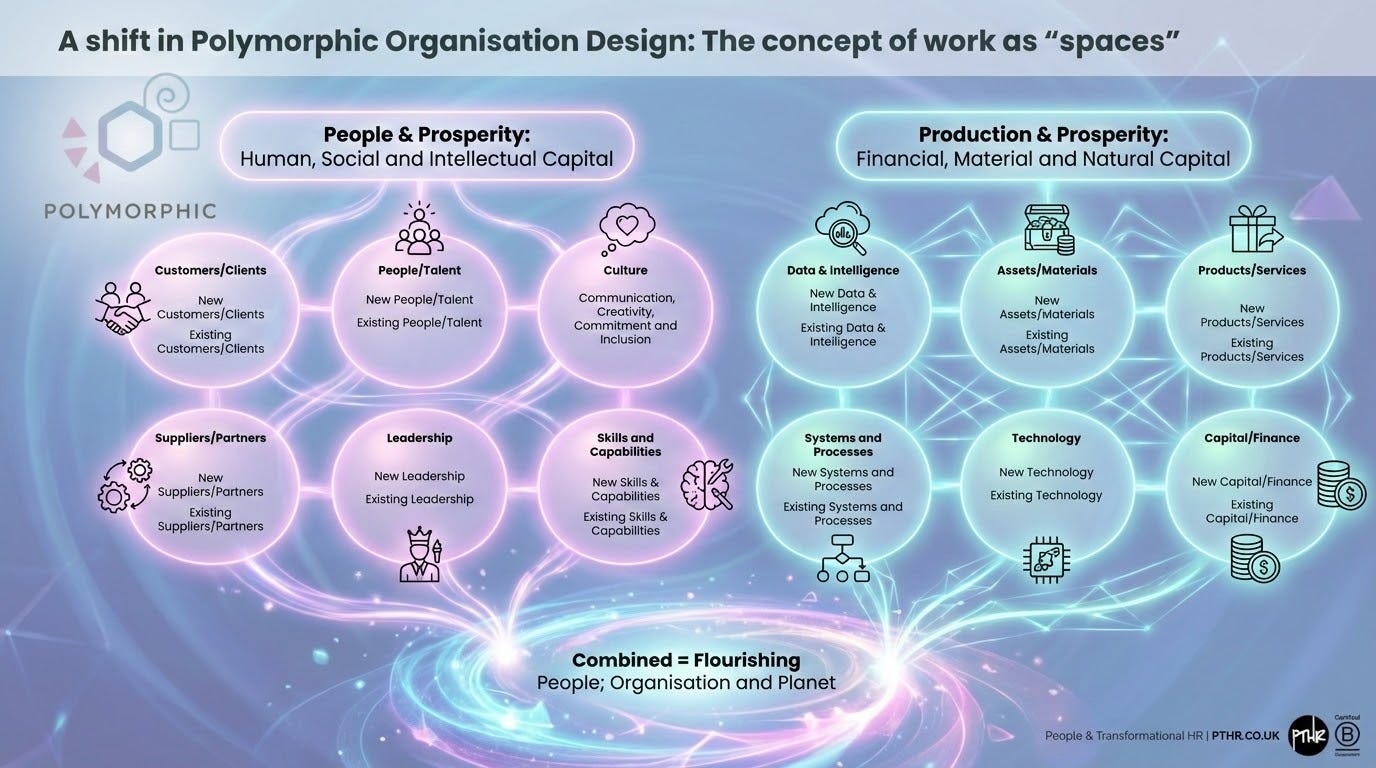
In Chronicle 3 we introduced the concept of work as Spaces. Not just traditional Divisions. The “places” where work lands, exists, calls people to do things. It’s either a total reorganisation of the enterprise into Spaces, or its a layer above, below or adjacent to the Org Chart decreed governance structure.
In Chronicle 8 we uncovered the Personal Best (PB90) Performance Management rebirth and the concept of Flywheels to plot, track and delivery true performance. Flywheels - largely brought into being by Jim Collins (in his From Good To Great book) - are the Kinetic Systems of holistic and momentum building performance.
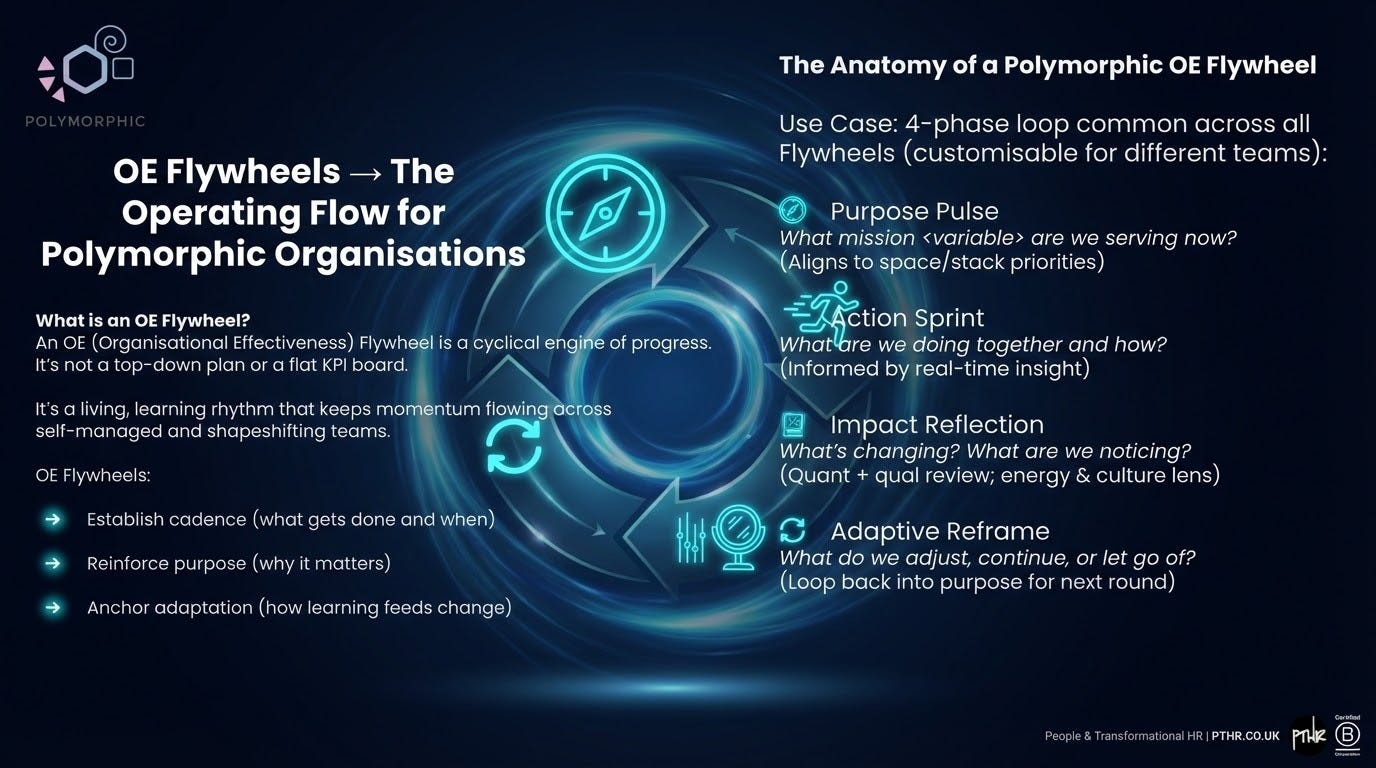
In our take on this, the “pushes” are things like continuous feedback, capability building, and purposeful work, which eventually create a self-sustaining momentum where “high performance” becomes an emergent property of the system rather than something you have to “manage” into existence.
In looking at work really gets done (and not just in the confines of the siloed Org Chart), we see what’s really going on in the complex adaptive system of work, workflows, value chains, impact and value creation.
Let’s quickly take a look at a few “laws” in organisational life and workflow.
Conway, Goldratt, Larman, Brooks and Little.
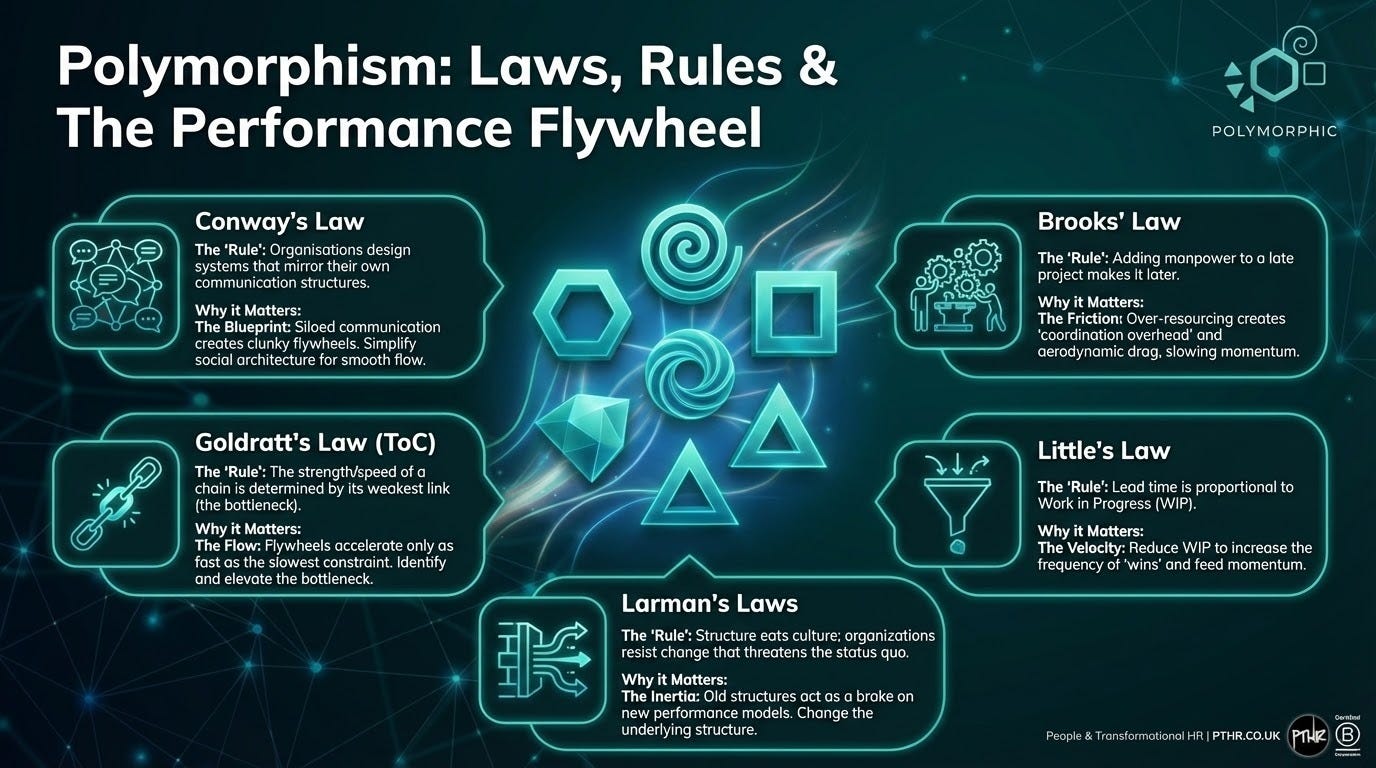
What these show us (in part) is this:
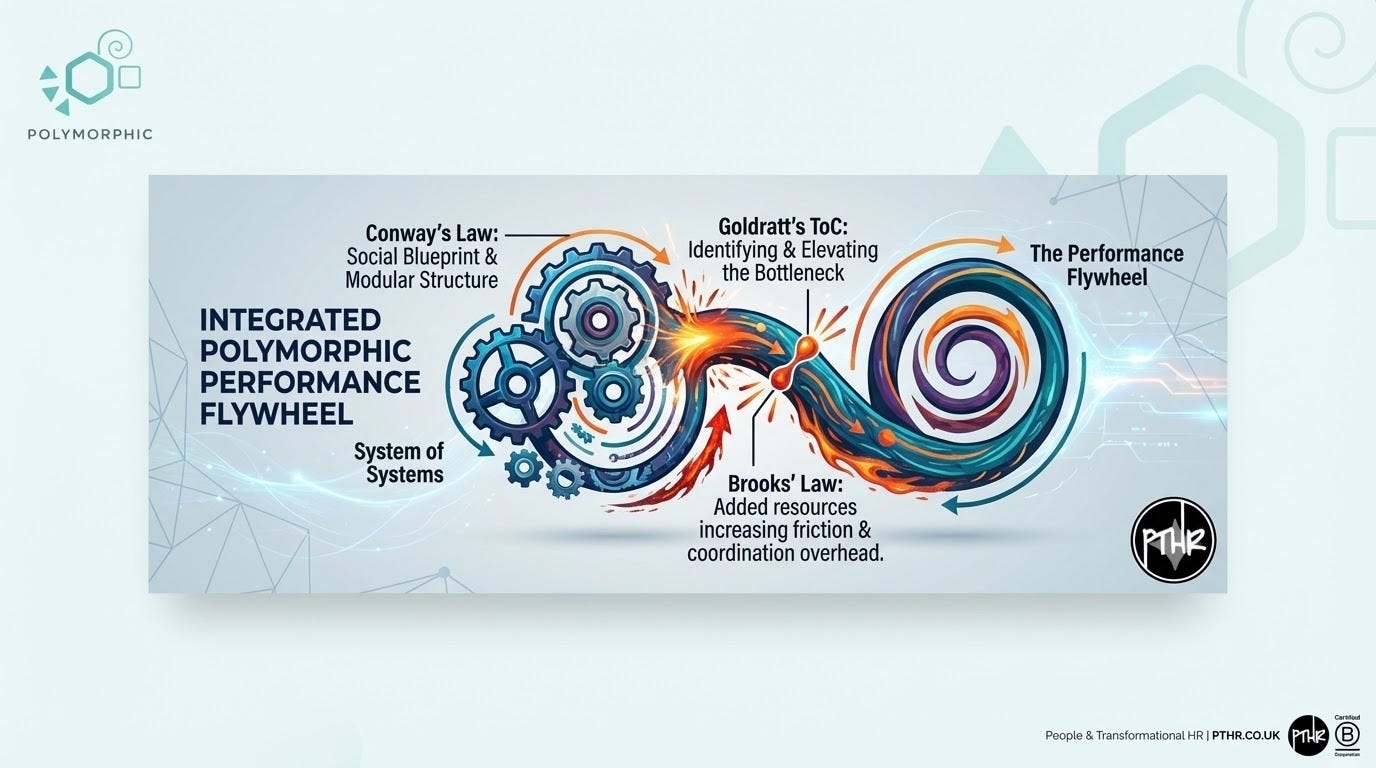
IF we don’t have our communication flow right (intelligence, state of play, values, prioritised work, decisions) and we hit bottlenecks or lags and we simply think we can throw more resource at it, these laws say this will fail.
Add in Larman’s law on structure over culture, and Little’s velocity law, and we are in trouble.
So why do we think restructuring will resolve our pain?
Yes, restructuring has become the default, knee-jerk and even enshrined in law and insolvency adminstrators responses to organisational failings.
And it is woefully inadequate. We all know it, yet we all perform in the theatre of rescue this way. And it isn’t deep, comprehensive, sophisticated or even viable enough.
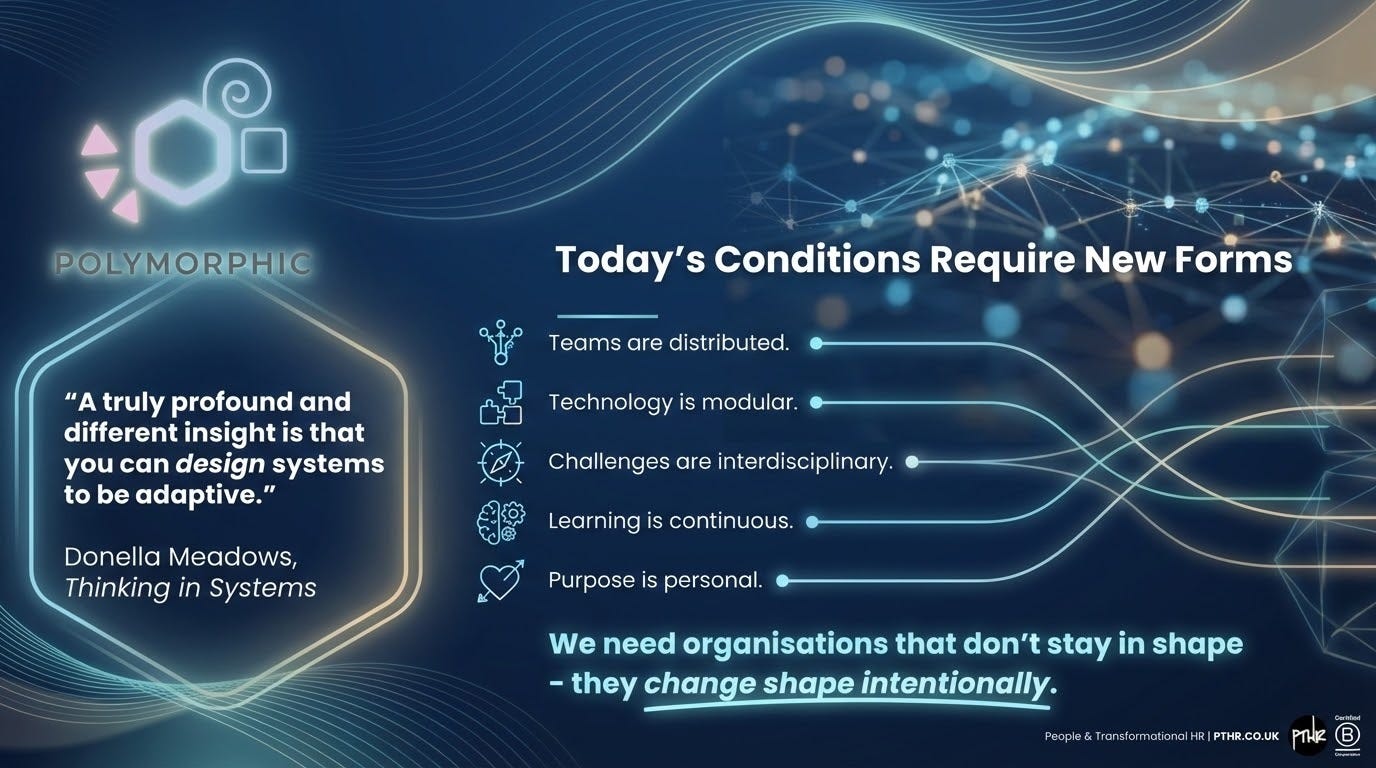
The whole conceptual genesis of a Polymorphic Organisation is "… an enterprise designed to change form, logic, and leadership energy in response to varying work demands, blending traditional and emergent structures constantly and deliberately."
Rendering restructing uneccesary, undesirable and obsolete.
And as famed Systems Thinker Donella Meadows says “…you can design systems to be adaptive.”
In recent a LinkedIn post Deepak Mohan has brilliantly posed this here. Provocatily titled “The Organisation Chart is a Lie”. In summarising/paraphrasing this post Deepak says this:
The real engine of delivery in organisations is not the hierarchy but what he calls collaboration networks.
These are the informal yet structured arrangements through which people actually solve problems and deliver outcomes.
They show up in different forms:
temporary clusters forming around a crisis or opportunity
cross-functional working groups delivering capabilities
communities of practice sharing expertise
ecosystems linking internal teams with partners, regulators, or suppliers
Most organisations depend heavily on these networks.
But they rarely design for them.
Instead, they assume that value flows down the hierarchy.
In reality, value flows across it. A key strand in Polymorphic Organisations’ DNA.
This is not a new insight. Systems thinkers have long pointed out the gap between the formal system and the system-in-use.
Chris Argyris described it as the difference between espoused theory and theory in use. The organisation chart describes the former. The lived experience of work reveals the latter.
What is new is that modern work — particularly knowledge work — increasingly depends on coordination that no hierarchy can fully pre-specify.
Problems are complex. Expertise is distributed. And solutions require people from multiple domains to collaborate quickly.
So collaboration networks emerge organically.
The problem is not that they exist. The problem is that we pretend they do not.
When Work Changes Faster Than Structure
Another lens on this shift comes from the emerging discussion about AI and job design.
People leaders like Anna Ott and workforce researchers such as Ben Zweig have begun arguing that the unit of analysis for work is changing. Here’s Anna’s LinkedIn post on this - another brilliant piece of writing.
Traditionally, organisations structured work around jobs.
A job had:
a title
a set of responsibilities
a level in the hierarchy
a place in the organisation chart
But AI is reshaping work at a different level.
Not the job level.
The activity level.
This is also brilliantly captured in emerging tech platform Beamible
A job, after all, is just a bundle of activities. Writing reports, analysing data, coordinating stakeholders, designing systems, making decisions, synthesising information.
Technology rarely replaces entire jobs overnight. Instead, it automates or augments specific activities.
When those activities change rapidly, the job itself begins to drift.
Titles become misleading. Levelling frameworks struggle to keep up. Hiring signals weaken. Pay benchmarking becomes confusing.
In other words, the architecture of work becomes unstable.
The deeper point here is subtle but important: the way organisations structure work often lags behind how work actually happens.
And when that lag grows too large, friction appears everywhere.
Which we also covered in Chronicle 19 - Absorption Debt
The Org Chart Fiction
The organisation chart persists because it performs an important role. It defines authority, it clarifies reporting lines, it provides accountability structures.
In other words, it helps govern the organisation.
But governance and value creation are not the same thing.
If you were to map how value actually flows through most organisations, you would likely see something closer to a network diagram than a hierarchy.
Nodes of expertise, clusters of collaboration, temporary teams forming and dissolving around problems, People moving across boundaries to get things done.
The hierarchy still exists, of course. But it acts more like a framework for accountability than a blueprint for how work really unfolds.
This is why many change programmes struggle. Which we covered in previous Chronicles here, here, and here.
A restructuring might look clean on paper. The reporting lines are simplified, the spans of control optimised, the functions neatly organised.
Yet something subtle breaks.
Because the redesign unintentionally cuts across collaboration networks that were quietly doing the real work (brilliantly pointed out by Deepak in his post).
The resistance that follows is often misinterpreted as cultural or political.
In reality, it is structural.
The redesign has disrupted the invisible system that actually delivered outcomes.
The Invisible Connectors
Every organisation has people who sit at the centre of these collaboration networks.
They are not always the most senior individuals. But they know how the organisation works. They know who to call when a problem appears and they connect domains that rarely interact.
Importantly so, (to Conway’s Law) they also move information across boundaries.
These individuals act as connectors or knowledge brokers and when they leave, something curious happens. Delivery slows and problems take longer to resolve. Coordination might appear to, and even absolutely becomes, harder.
It is not because those individuals were simply talented.
It is because they were holding together networks that the formal structure never recognised.
If the organisation had intentionally designed and supported those networks, their departure would matter far less. But when networks remain invisible, capability becomes dependent on individual heroics.
And heroics are a fragile operating model.
Enter Self-Organised Teams and the concept of Self-Management.
Now, those of you who know me know this is my thing. I’ve deliberately followed, learned, explored, introduced, taught and eulogised about non-hierarchical, flat, self-organised and self-managed teams and organisations.
This COULD be a post in its own right and will probably appear and re-appear time and again. But I’m going to start here as the Org Chart and Self-Managed Organisations are almost polar opposites. I say almost as we know there is still structure in self-managed teams - they are not often devoid of any “scaffold”, but they are anti-pyramidal. And often build themselves - and I’ve done this time and again - as connected, nested, concentric circles
Something about the wonder that is rounded shapes not angular - and certainly not “apexed” shapes - really appeals to those of a self-management disposition.
So on that, Deepak’s Org Chart crituque is even more shot to pieces.
As is Anna’s Job construct. Although some look like jobs and are called roles. Not simply a relabel, but a new ethos on aligned autonomy and congruent accountability.
Gosh, I really need to stop myself turning this into a Self-Management Epoch here.
Right, back to the Org Chart myth and where Self-Management wins and flails somewhat.
People get attached to things. Like a title. A Job Description. A Team. A mantra. A mental model and in some cases (even though they might not admit it) being told what to do and having an escalation path for accountable decisions. Yes the traditonal constructs seem to serve some people well.
And then self-managed appears. And it’s tempting. Desired even.
Deci & Ryan’s Self-Determination Theory doesn’t just say we might like autonomy a little bit, it’s an inbuilt psychological desire, urge and need. Along with competence/mastery and a sense of relatedness (to others, things, missions, constructs, quests etc).
So, when we declare an interest or even the adoption of forms of Self-Management there is likely an intial positive reaction.
“No more micro-management”
“I get to have a say in how things go for me and what we do in our work”
“No more futile performance reviews”
“We get to be adults”
“I have choices”
“I can be included in ways I didn’t think possible”
And of course, some dread, fear, uncertainty, confusion and worry. Because not all of us like the thought of being totally liberated.
Anyway, I’ve come to understand that the concept of self-management and its appeal and the actuality can be very different.
Coasting, social loafing, avoidance, distortion, gaming, distraction, shrinking into a “job”, vague offers, showing rather than doing. Over-indexing on self-indulgent or self-appeasing work. Delusions of granduery. Ignoring system challenges. Not giving or receiving feedback well or at all. Deferring “up”. Expecting “someone” to resolve something. Tensions unsurfaced. Needs unmet. Words unspoken. Decision drift, avoidance or imposition.
Yes, there are LOTS of downsides to Self-Management when people aren’t with the spirit, don’t really get it and bring it more to the “self” and none of the “management”.
Why Self-Managed Systems Sometimes Fail
This discussion also sheds light on something else then: why some self-organised or self-managed systems struggle.
Over the past two decades many organisations have experimented with models that reduce hierarchy. I’ve been fascinated since then and delved into lots of studies, examples and even built PTHR on this one rule: We will be self-managed.
Many of us in this arena have drawn inspiration from:
Sociocracy
Agile team structures
Teal organisations
Freedom-centred/L’enterprise Liberté
Holacracy
Adhocracy
Heterarchy
Wirearchy
Networked and Platform enterprises
The intention is often admirable: increase autonomy, reduce bureaucracy, and allow teams to organise themselves around work.
Yet some of these experiments fail.
When they do, critics often conclude that self-management itself does not work.
But the deeper issue is often different.
Many attempts at self-management remove hierarchy without replacing it with a coherent alternative architecture for coordination.
Hierarchy, for all its flaws, performs several essential functions:
allocating resources
resolving conflicts
clarifying decision rights
aligning priorities
When hierarchy disappears but no new mechanisms take its place, confusion quickly emerges.
Teams duplicate effort. Decisions stall. Accountability blurs. The organisation swings from rigidity to chaos. What is needed is not the absence of structure, but a different kind of structure.
One that reflects how work actually happens.
Confession: Last year, I nearly lost my sense that self-management/self-organising teams was the thing for me.
And Polymorphic Organisations saved me from that mourning and loss. Because I see self-management differently now.
Participation in a system that helps you have the best of self ; with the necessary stabilising/clarifying management; and most importantly, contextual shape-shifting so you “know where you are”.
Enter Flywheel Teams
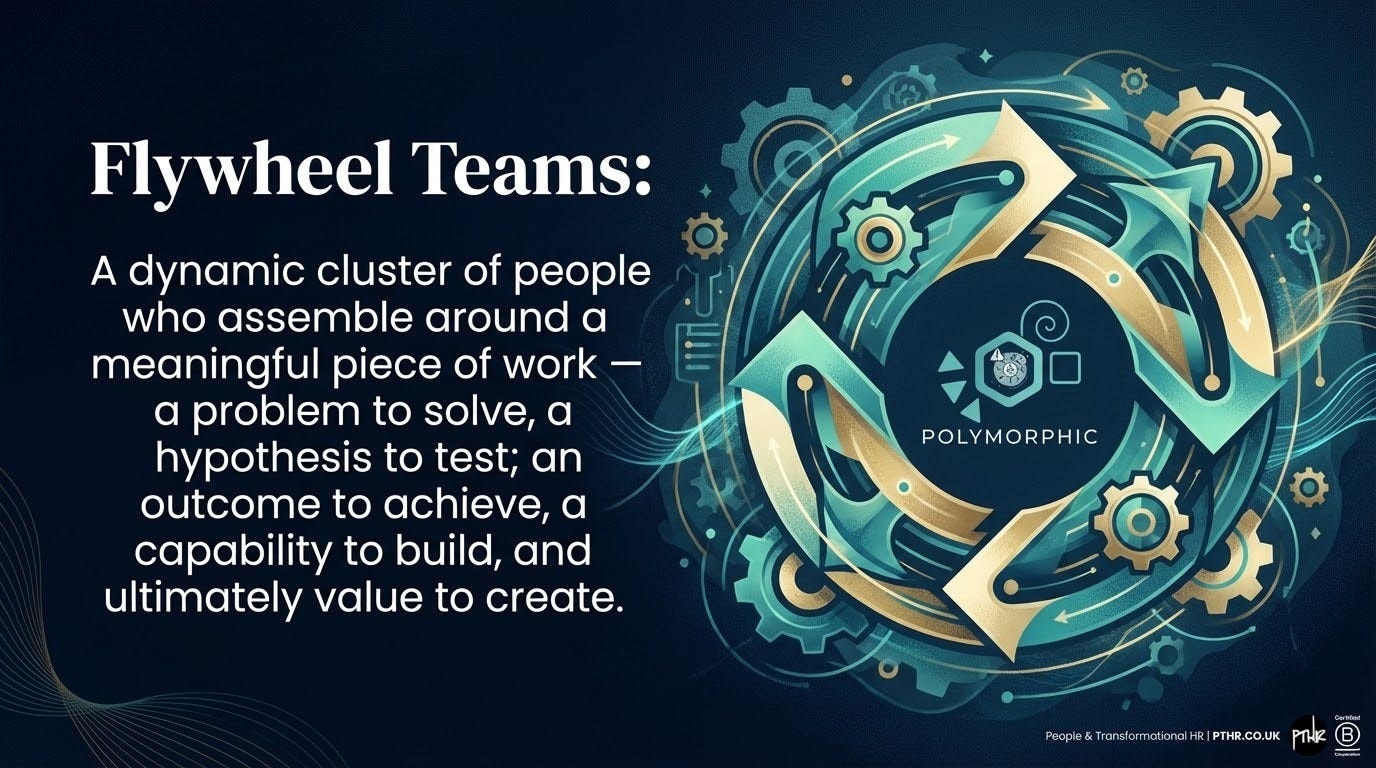
One way to describe this emerging structure is through the idea of Flywheel Teams.
A Flywheel Team is not a permanent department. It needs self-management to a large degree. And it needs management of the value you can create - individually and collectively.
It is a dynamic cluster of people who assemble around a meaningful piece of work — a problem to solve, an outcome to achieve, a capability to build.
Members of a Flywheel Team may come from anywhere in the organisation.
They bring:
expertise
judgement
relationships
creativity
commitment
and increasingly, AI tools that amplify their contribution
Once the work is complete, the team may dissolve or evolve.
Another Flywheel Team forms elsewhere.
Over time the organisation becomes less like a rigid hierarchy and more like a system of rotating flywheels - each one generating momentum around a particular outcome.
And this metaphor really matters. A flywheel builds energy gradually. It gathers people, ideas, and resources. Once in motion it produces sustained momentum.
And crucially, multiple flywheels can operate simultaneously.
This reflects how many organisations already function.
Product launches, regulatory responses, innovation initiatives, transformation programmes - all of these often rely on cross-functional teams that assemble temporarily to drive progress.
Flywheel Teams simply make this pattern explicit.
Designing for Networks Instead of Fighting Them
If collaboration networks are already doing much of the work, the logical step is not to suppress them but to design around them.
This means asking different questions.
Instead of asking:
“Who reports to whom?”
We might ask:
“Where does value actually get created?”
Instead of asking:
“Which department owns this?”
We might ask:
“Which network of expertise delivers this outcome?”
Instead of designing only reporting structures, we begin designing collaboration structures.
That design might include:
identifying load-bearing networks
recognising key connectors
providing shared infrastructure for collaboration
aligning governance with real decision flows
This is where organisational design begins to shift from static charts to dynamic systems.
The Polymorphic Organisation
These ideas sit at the heart of what I have been exploring as Polymorphic Organisations.
The term comes from computing, where polymorphism describes an entity that can take on different forms depending on context. Applied to organisations, it means something similar.
People are not confined to a single rigid role.
Teams are not permanently fixed.
Capabilities can be recombined in different ways depending on the problem at hand.
In a polymorphic organisation, structure becomes more fluid. Not chaotic — but adaptive.
The hierarchy still exists for governance and some well-established stable operations, but value creation increasingly happens through dynamic combinations of people, capabilities, and networks.
Flywheel Teams are one way of describing how that recombination occurs in practice and give new life to self-managed, self-organised teams of autonomous humans.
A Different Way to See the Organisation
Imagine looking at an organisation not as a hierarchy but as a landscape of activity.
Across that landscape multiple flywheels are spinning. One might be delivering a product innovation. Another responding to regulatory change. Another improving customer experience. Another building a new digital capability.
Each flywheel draws people from different domains.
Some individuals may participate in multiple flywheels simultaneously, contributing different capabilities in each.
Leadership becomes less about directing work down the hierarchy and more about stewarding the system:
ensuring the right flywheels exist to deliver on the mission and purpose, through the values and with the culture that sees us stronger.
removing friction between them and providing shared platforms and resources
maintaining clarity about outcomes and accountability, prioritised efforts, sparks of innovation test-and-learn feedback loops and ultimately things that people see keep this organisation future-ready and adaptable, whilst taking care of what matters right now.
In such a system, coordination emerges from design rather than control.
The New Scarce Resource
As technology reduces the cost of producing output, another shift occurs.
Output itself becomes less scarce. What becomes scarce instead is:
judgement
empathy
inventiveness
attention
integration
accountability
AI can generate drafts, analyses, and recommendations at extraordinary speed.
But determining whether those outputs are correct, relevant, or wise still requires human judgement.
Flywheel Teams work well in this context because they bring together different forms of judgement around an outcome.
Technical insight.
Operational experience.
Customer understanding.
Strategic perspective.
The goal is not simply more output.
It is better decisions.
Mapping the Real Organisation
A useful exercise for any organisation is to map a recent cross-functional initiative and trace how it actually unfolded.
Who spoke to whom?
Where were the informal checkpoints?
Which individuals connected different domains?
Which collaboration networks carried the work forward?
Once that map exists, an important question follows.
Does the current operating model support those networks?
Or does it accidentally make their work harder?
If the latter, there is an opportunity for redesign.
Not necessarily by adding more hierarchy, but by strengthening the structures that already enable collaboration.
Designing the Flywheel Organisation
The emerging organisational challenge is not simply to flatten hierarchies or adopt new buzzwords. It is to design systems that acknowledge the reality of modern work.
This may involve several shifts.
Recognising collaboration networks, self-managed teams and shape-shifting approaches as legitimate structures.
Supporting cross-functional teams as primary vehicles of delivery.
Clarifying decision rights even when teams span boundaries.
Providing shared platforms that allow people to move between flywheels without friction.
In essence, organisations must become more intentional about the patterns of collaboration that already exist.
The Question Leaders Should Ask
Perhaps the most revealing question a leadership team can ask is this:
What are the three most important collaboration networks in our organisation right now?
And then:
Do we understand them?
Do we support them?
Or
Are we relying on them without recognising their importance?
Because if the organisation chart is only a governance diagram, then the real operating model is somewhere else. It lives in the networks of trust, expertise, and coordination that quietly deliver outcomes every day.
The task of modern organisational design is not to eliminate those networks.
It is to see them clearly — and design the organisation around them.
Flywheel by flywheel.