The Polymorphic Organisation Part XXIX - Entry-level Work
A fast forward to 2029 - how will younger people and career returners get over the work "threshold" with AI and Automation rife in our enterprises?

Eroded rungs
My read is this: By 2029, the biggest risk is not that all young people will be “replaced” by AI. It is that the traditional first rung of the ladder keeps eroding faster than institutions can redesign it.
The emerging pattern is less “sudden job apocalypse” and more “starter work hollowing out”: Fewer classic junior roles, higher expectations on day one, more AI-mediated task execution, and a widening gap between formal education and actual organisational demand.
Working thesis for 2029
If GenAI and early agentic systems keep diffusing at roughly their current pace, then by 2029:
Early-career work will exist, but less as a bundle of routine tasks and more as a mix of orchestration, judgment, verification, relationship work, contextual problem-framing, and AI supervision.
Employers will increasingly expect new entrants to arrive with baseline AI fluency already in place, because the old “learn the basics by doing the admin” model is being weakened.
That is already visible in consulting and labour-market research:
BCG reports that rising expectations are reshaping entry-level pipelines, with new hires expected to contribute at a higher level from day one.
McKinsey sees high-AI-exposure job ads falling faster than low-exposure ads; and
LinkedIn projects that by 2030, 70% of the skills used in most jobs will change.
So the 2029 question is not simply “Will there be entry-level jobs?” It is:
Will we still have enough developmental work to turn novices into professionals?
That appears to be the real societal faultline.
1) What academia is actually finding
The most important academic point is that the evidence is now mixed, but worrying in one very specific place: early-career white-collar pathways.
A Stanford/NBER paper using high-frequency ADP payroll data found that early-career workers aged 22–25 in AI-exposed occupations experienced a 16% relative employment decline, with effects concentrated where AI appears to automate rather than augment labour. The same paper also reports a 6% decline in employment for 22–25-year-olds in the most AI-exposed occupations from late 2022 to September 2025, versus growth for older workers in the same occupations. The authors are careful: they say the evidence is consistent with GenAI disproportionately impacting entry-level workers, not that the entire causal story is settled.
Anthropic’s own March 2026 labour-market analysis is more cautious, but still notable. It finds no clear unemployment spike in the most exposed occupations, yet it does find tentative evidence that hiring has slowed slightly for workers aged 22–25 in those professions, and it flags programmers, customer service representatives, and financial analysts as among the most exposed occupations.
At the same time, Humlum and Vestergaard’s NBER paper on Denmark is a useful counterweight. They replicate declines in early-career jobs in exposed occupations, but argue those declines are not explained simply by firm adoption of AI chatbots. They find modest time savings, occupational mobility effects, and little evidence yet of large earnings or hours effects. In other words: disruption is visible, but the mechanism is more complex than “firms bought chatbots, therefore juniors disappeared.”
That balance matters. The academically honest summary is:
There is now credible evidence of starter-job stress in exposed fields, but not yet decisive evidence of universal AI-caused mass youth unemployment.
2) What the big institutions are saying
OECD is now plainly warning (here) that young people face “potential competition with AI for entry level jobs,” and places that warning alongside existing youth labour-market fragility, especially in countries with high NEET rates. This is significant because OECD is not prone to melodrama.
The World Economic Forum is similarly explicit. Its April 2025 analysis says 40% of employers expect to reduce their workforce where AI can automate tasks, while also projecting technology-driven job creation and displacement at the same time. In its later briefing with PwC, the Forum reports that entry-level workers are more curious and excited than worried overall, but still anxious about security and skill relevance.
That combination is crucial. The macro institutions are not saying “no problem.” They are saying:
the labour market is being reconfigured
young people are exposed first
sentiment is not pure fear, but confidence is uneven
adaptation capacity will decide outcomes.
3) What consulting firms are seeing inside organisations
This is where the story gets a little more concrete.
McKinsey’s UK analysis says job adverts in high-AI-exposure occupations have dropped more sharply than in low-exposure occupations, and it explicitly warns that young graduates may be facing a triple-whammy:
a broad labour market slowdown,
a sharper decline in graduate-level openings, and
weaker demand in some of the lower-skilled roles that often give graduates their first foothold.
McKinsey’s recommendation is not to freeze early-career hiring, but to reshape work and keep investing in junior talent so the pipeline does not break.
BCG goes further into organisation design. It says AI is redefining work, broadening roles, flattening hierarchies, and redefining the need for junior, coordinator, and manager roles. It also says rising expectations are reshaping entry-level pipelines, because routine tasks are being automated and new hires are expected to contribute at a higher level from day one. Yet BCG does not conclude that entry-level pipelines should vanish; one of its recommended archetypes explicitly says they should evolve, not disappear, supported by intentional development tracks, rotations and AI-enhanced pathways.
PwC’s 2025 AI Jobs Barometer is important because it pushes back against the lazy “AI = pure cost cutting” narrative. It argues companies using AI just to cut staff may miss bigger growth gains, and its data suggests stronger job demand growth in augmented occupations than in more automated ones. In PwC’s entry-level work analysis with the WEF, it also reports that entry-level workers are learning fast, but many doubt how much of their skills base will still be relevant in three years.
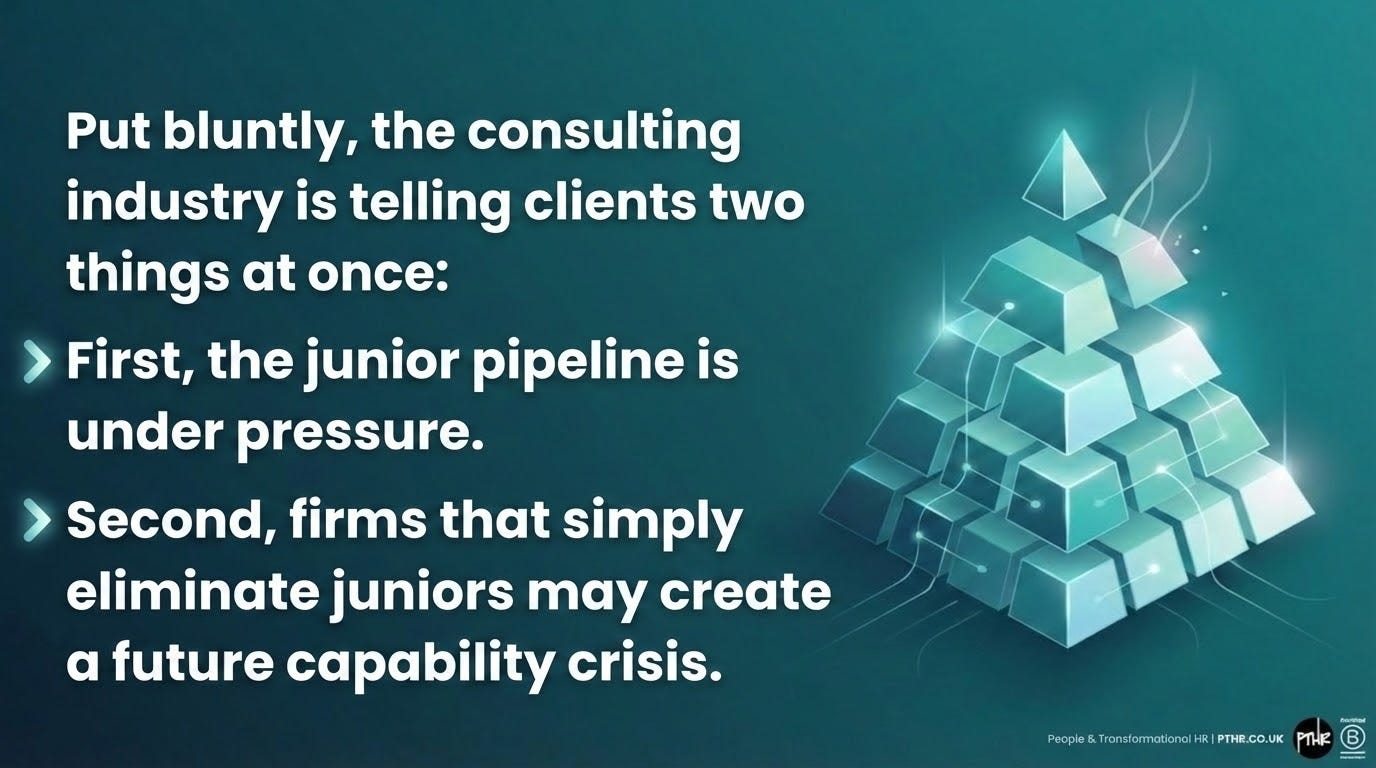
Put bluntly, the consulting industry is telling clients two things at once:
First, the junior pipeline is under pressure.
Second, firms that simply eliminate juniors may create a future capability crisis.
4) What labour-market and platform data are showing
LinkedIn’s January 2025 Work Change Report says professionals entering the workforce today are on pace to hold twice as many jobs over their careers as people did 15 years ago, and that by 2030 70% of the skills used in most jobs will change. It also reports a 140% increase since 2022 in the rate at which members add new skills to their profiles. This is not a stable ladder story. It is a fluid, high-churn, skills-first story.
Indeed’s 2025 AI-at-work research takes a similar direction. It argues the main issue is not wholesale replacement, but transformation. Still, its numbers are stark: 26% of jobs posted on Indeed could be highly transformed by GenAI, with another 54% moderately transformed. Then in a separate 2025 labour-market update, Indeed reports that postings with junior job titles fell 7% between August 2024 and August 2025, while senior postings edged up. In software development, only around 2% of postings were junior as of August 2025.
Even where firms are optimistic, they are changing the shape of work. Microsoft’s 2025 Work Trend Index describes the emergence of “Frontier Firms” built around human–AI collaboration and agentic ways of working. Those firms report higher optimism and performance, but that also implies that the normal baseline for work is shifting fast toward AI-embedded execution.
The implication for 2029 is clear: there may be work, but it will not look like the old “do five years of administrative grind before anyone trusts you” model.
5) What industry experts are saying
Industry voices are split between alarm and redesign.
Dario Amodei’s public warning in 2025 - that AI could wipe out roughly half of entry-level white-collar jobs within five years—was deliberately provocative, but it is not wholly detached from the underlying evidence. Anthropic’s own later research is more measured, yet it still identifies exposed occupations and slight slowing in young-worker hiring. So the sensible stance is: Amodei’s headline forecast is not established fact, but the direction of concern is grounded.
Aneesh Raman at LinkedIn has framed the issue as the “bottom rung” of the career ladder breaking. That language resonates because it matches what the organisational data is showing: not necessarily the disappearance of work, but the disappearance of developmental scaffolding. Even business coverage of Raman’s argument leans on LinkedIn’s wider skills data showing more non-linear careers and faster skill churn.
That distinction matters.
The real fear is not only unemployment.
It is deprofessionalisation by omission.
If fewer people get the chance to practice judgment on progressively harder work, we will not just fail the young; we will also fail the future senior/specialist pipeline.
6) What education commentators and innovators are seeing
Education is apparently not asleep here. But it is uneven, and that unevenness is becoming dangerous. Which worries me immensely.
Gallup/Lumina found in 2026 that 16% of college students had already changed their major because of AI’s potential labour-market impact, and many more were factoring AI into enrolment and career choices.
HEPI’s 2026 UK survey found AI use was now near universal among undergraduates: 95% reported using AI in at least one way, and 68% said AI skills are essential for thriving today. But fewer than half felt teaching staff were helping them build those skills for future careers. HEPI’s recommendations are telling:
structured AI induction,
curriculum redesign,
clear guidance,
better access, and
staff development.
Jisc reports UK students are worried about employability and want to be “partners not passengers” in AI adoption, with stronger career guidance and fairer support.
The Digital Education Council’s 2025 employer-facing work is one of the sharpest signals. Across employers in 29 countries and 18 industries, 72% anticipated reductions in headcount, and only 3% believed higher education was adequately preparing graduates for an AI-driven future. That is a brutal indictment of the education-to-work handoff.
At the same time, there are live innovations. Northeastern’s College of Professional Studies has launched a comprehensive AI literacy initiative built around guidelines, faculty integration, community practice and student-facing expectations, explicitly saying AI literacy is now central to preparing students for what comes next.
At school level, the EC/OECD-backed AILit Framework is being built to make AI literacy durable, interdisciplinary and globally usable, linked to PISA 2029 media and AI literacy assessment goals.
Governments are moving too. The UK announced in 2026 that every adult would be eligible for free benchmarked AI courses, with an ambition to upskill 10 million workers by 2030, plus funding for tech pathways and graduate traineeships.
So education is beginning to respond.
But the core problem is pace.
Students are already living in the AI future faster than institutions are redesigning for it.
7) So what will entry-level work probably look like by 2029?
Not one thing, but a new pattern.
1. Fewer pure “do the routine stuff” roles
The classic junior analyst, junior researcher, junior developer, junior coordinator and junior content producer roles will be thinned where their core work is summarising, drafting, first-pass coding, pattern extraction or document preparation. That trend is already visible in exposed occupations and in the way firms describe new-hire expectations.
2. More “AI-augmented apprentice” work
The more plausible surviving starter role is not “no-skill assistant” but “AI-enabled junior operator”: someone who can prompt, check, critique, escalate, contextualise, and communicate. That aligns with BCG’s and PwC’s augmentation logic, and with Indeed’s “hybrid transformation” framing.
3. Higher thresholds for entry
Graduates will increasingly be expected to arrive with portfolio evidence, AI fluency, domain familiarity, and proof of judgment. “Train me from scratch” will be less available in many knowledge sectors.
4. More non-linear entry points
Instead of a single first rung, there will be fragmented pathways: project work, micro-apprenticeships, internal marketplaces, hybrid study-work models, sector bootcamps, portfolio credentials, and role clusters rather than neat jobs. LinkedIn’s skills data and the move toward more fluid careers support this.
5. A sharper divide between “prepared” and “unprepared” entrants
Young people with access to AI tools, mentoring, networks, and practical work-based learning will move faster. Those without that support may find the market brutal. OECD, Jisc, HEPI and the Digital Education Council all point to access, readiness and support gaps as major issues.
So by 2029, the danger is not just fewer jobs. It is more selective, less forgiving, more accelerated entry.
8) Why this is especially dangerous socially
Because starter jobs do more than create income.
They create:
identity
socialisation
tacit knowledge
professional norms
confidence
network effects
upward mobility.
If AI strips out the low-risk, routine, novice-friendly work without redesigning new pathways for learning, then millions of younger people do not just lose jobs. They lose formation.
That is why this matters politically and morally as much as economically. OECD’s warning on youth mobilisation, WEF’s concern about inequality, and Jisc’s call to treat students as partners all point in the same direction: this is becoming a structural inclusion issue.
9) Where Polymorphism gives us an edge
A Polymorphic Organisation does not start with “How do we preserve old jobs?” It starts with:
How do we continually recombine work, capability, technology and human development so the system stays adaptive and humane?
That is exactly the challenge here.
A. Replace the broken ladder with a portfolio of entry pathways
If one bottom rung is disappearing, build many. A polymorphic system can create multiple legitimate entry modes: short-cycle projects, rotational pods, contribution marketplaces, shadow assignments, peer cells, community missions, and AI-assisted apprenticeship tracks.
Instead of one junior job, create a developmental entry ecosystem.
B. Design roles as evolving capability containers, not static job boxes
The old junior role often existed because someone had to do repetitive sub-tasks. In 2029, those tasks will be unstable. Polymorphism allows roles to be defined around capability growth: sense-making, coordination, stewardship, judgment, experimentation, relationship-building, ethical checking, and human escalation.
That means young people are not hired to be “the human version of the admin.” They are hired into growth architectures.
C. Build AI-augmented apprenticeship deliberately
One of the biggest risks is that AI removes the practice reps novices need. Polymorphic design can counter this by making AI part of apprenticeship:
AI for first draft
human novice for critique
peer or mentor for escalation
team for reflective learning
repeated cycles that build judgment.
That preserves throughput while still producing professionals.
D. Turn internal labour markets into development markets
A polymorphic organisation can use internal gigs, cross-functional missions and temporary work cells to create the equivalent of old starter work without relying on bloated permanent junior structures. This matters because firms may resist fixed junior headcount, but they still need talent formation.
So the answer is not “bring back 2008 graduate schemes exactly as they were.”
It is: create fluid developmental work at scale.
E. Make “human edge” work explicit
By 2029, the premium will be on:
contextual judgment
trust-building
interpretation
coordination across ambiguity
ethical discernment
system navigation
live human communication.
Polymorphism is strong here because it already assumes variety in forms, roles and responses. It is a better fit for a world where work is less about repetition and more about intelligent adaptation.
F. Create novice-safe zones
This may be the most important move.
Every polymorphic organisation should have protected spaces where early-career people can practise decision-making, handle bounded risk, and learn with support. Without that, AI will compress experience requirements upward and make “entry” almost paradoxical.
You could call these:
learning pods
capability studios
supervised delivery cells
shadow-to-steward pathways
craft labs.
But the principle is simple: protect the formation layer.
G. Reward organisations for producing talent, not just consuming it
A profound 2029 challenge will be that many firms will want “AI-ready” talent without paying to develop it. Polymorphism could push a different norm: measure organisations partly by how effectively they convert novice potential into system value.
That is a strong policy and business argument: the firms that keep talent pipelines alive will have a long-run edge in resilience, succession and innovation. McKinsey and BCG both point in this direction already.
10) A sharper argument for executives and educators
We might frame the core provocation like this:
AI is not just threatening jobs. It is threatening the social machinery by which societies turn educated young people into experienced adults.
And then:
Polymorphic organisation design may be one of the few viable responses because it can multiply entry points, distribute learning, redesign work dynamically, and keep development alive even when routine work is automated.
That feels like the heart of our task here.
11) A provisional 2029 forecast in one “mini-manifesto”
By 2029, early careers will probably be more fragmented, more AI-mediated and less forgiving than they were in the pre-ChatGPT era.
In many sectors, fewer people will start with repetitive junior tasks, because those tasks will be automated, compressed or absorbed into agentic workflows.
The graduates who succeed will be those able to use AI fluently while adding judgment, relational intelligence, systems awareness and contextual thinking.
The organisations that succeed will be those that redesign entry-level work rather than remove it:
creating AI-augmented apprenticeships,
fluid role architectures,
internal talent marketplaces and
protected developmental pathways.
Without that redesign, societies risk creating not only youth unemployment, but a broken professional pipeline.
12) Bottom line
The evidence does not yet justify saying “millions of young people will definitely be jobless by 2029.”
It does justify saying that the first stage of professional life is being re-engineered right now, that exposed entry-level pathways are already under pressure, and that education, employers and policymakers are behind the curve in redesigning what comes next.
That is exactly where Polymorphism has force:
not as a decorative theory of flexibility, but as a practical answer to a real civilisational design problem.